
One roll of the bowl
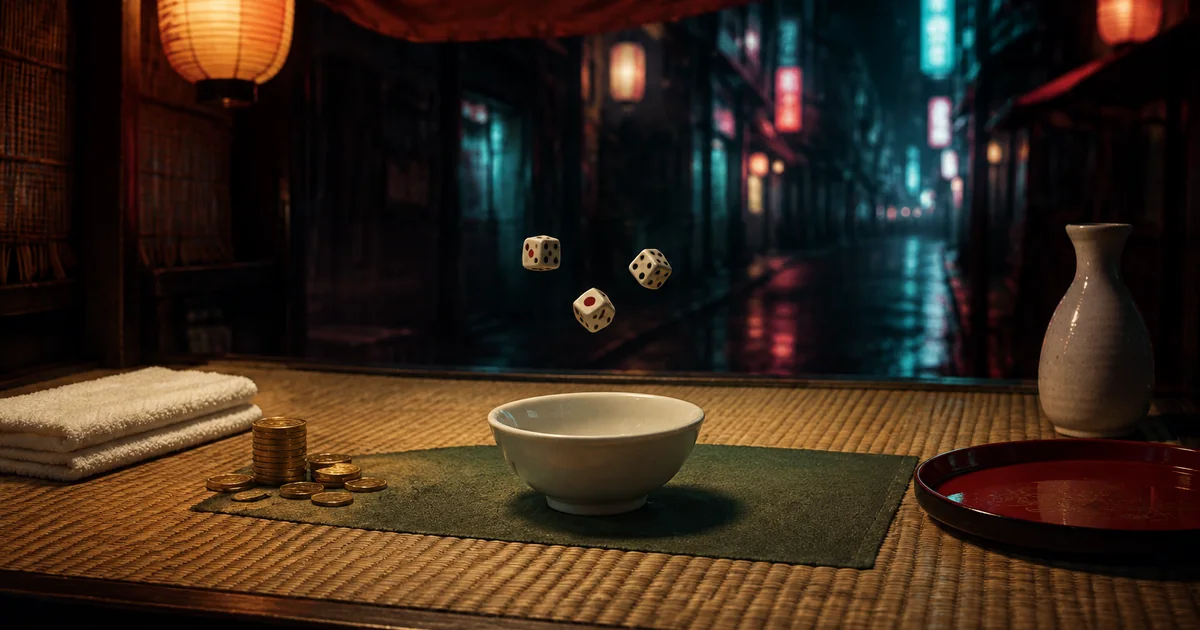
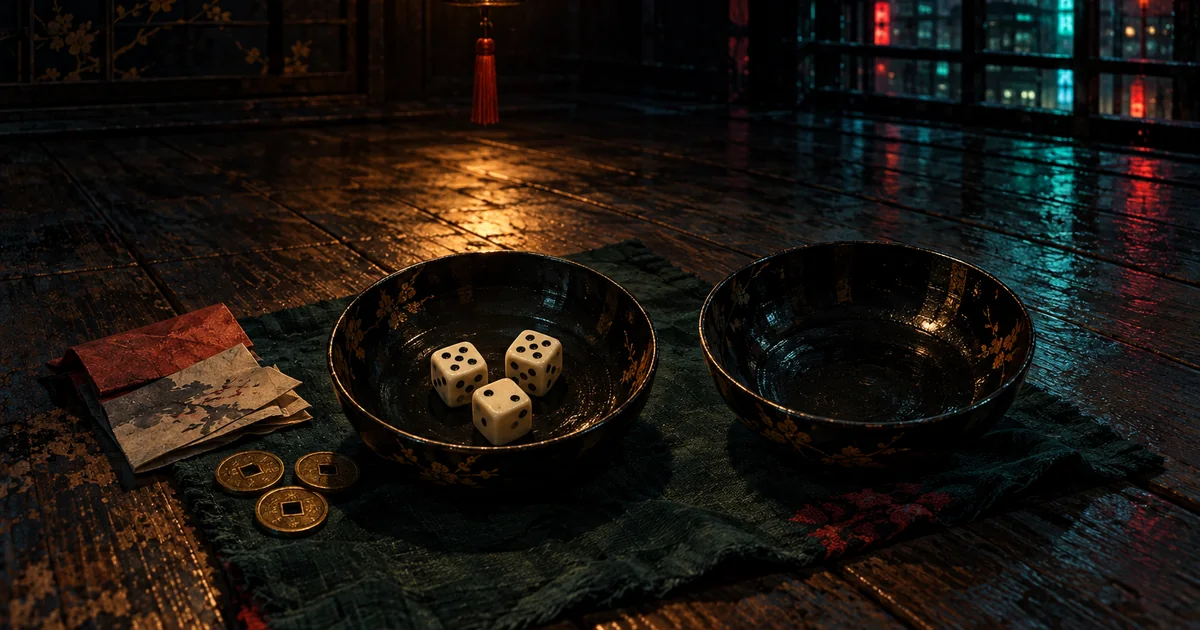
Chinchiro is three dice in a bowl, up to three throws to make a hand, and a duel against the dealer. We have written up the rules and the payout table before; this piece prices them. Every number below is computed from the engine’s own derivation and settlement code, with no simulation and no rounding — the dice are honest, so the arithmetic is exact.
| HAND | ROLLS | CHANCE PER THROW |
|---|---|---|
| Pinzoro 1·1·1 | 1 | 0.46% (1 in 216) |
| Arashi (any other triple) | 5 | 2.31% |
| Shigoro 4·5·6 | 6 | 2.78% (1 in 36) |
| Hifumi 1·2·3 | 6 | 2.78% (1 in 36) |
| Point (a pair plus an odd die) | 90 | 41.67% (5 in 12) |
| No hand | 108 | 50.00% |
A pair has 6 values × 5 odd dice × 3 positions = 90 rolls; each point value 1–6 is equally likely at 15 rolls. Exactly half of all throws make nothing, which is why the game gives you three.
Three attempts change the numbers in one clean way. A side keeps throwing only while it has no hand, so the chance of finishing with any given hand is its one-throw chance times 1 + ½ + ¼ = 7⁄4, and the chance of finishing with nothing is (½)³ = 1⁄8.
| HAND | CHANCE |
|---|---|
| Point | 72.92% |
| No hand | 12.50% |
| Shigoro | 4.86% |
| Hifumi | 4.86% |
| Arashi | 4.05% |
| Pinzoro | 0.81% |
Each point value 1–6 finishes at 12.15%. The same table applies to the dealer and to you; what differs is who rolls first and what each hand pays.
The dealer rolls first
The round is settled by the dealer’s hand before you touch the dice, three times in ten. A dealer special — pinzoro, arashi or shigoro, together 9.72% of rounds — takes the stake outright. Dealer hifumi, 4.86%, pays you ×3 without a throw. Dealer no-hand, 12.50%, is a push: the stake comes back. Only a dealer point, 72.92% of rounds, puts the dice in your hand.
| DEALER FINISHES WITH | CHANCE | YOUR STAKE | CONTRIBUTION TO THE RETURN |
|---|---|---|---|
| Pinzoro / arashi / shigoro | 9.72% | lost | 0.00% |
| Hifumi | 4.86% | ×3 | 14.58% |
| No hand | 12.50% | returned (push) | 12.50% |
| A point | 72.92% | you roll | 70.30% |
| Total | 100% | 97.38% |
The last column is chance × average return in that branch. Against a dealer point your average return is 96.41%, which is where the next table comes from.
Against a point
When the dealer holds a point you roll the same three attempts and are paid by the table: ×6 for pinzoro, ×4 for arashi, ×3 for shigoro, ×2 for a higher point, nothing for a tie, a lower point, hifumi or no hand. Your specials do not care what the dealer’s point is; your point does, and a tie goes to the dealer. So the duel is six different bets, one per dealer point.
| DEALER POINT | YOU WIN | RETURN |
|---|---|---|
| 1 | 70.49% | 157.18% |
| 2 | 58.33% | 132.87% |
| 3 | 46.18% | 108.56% |
| 4 | 34.03% | 84.26% |
| 5 | 21.88% | 59.95% |
| 6 | 9.72% | 35.65% |
| Average | 40.10% | 96.41% |
“You win” = your specials (9.72%) plus a point higher than the dealer’s (12.15% per value above it). Return counts the specials at ×6/×4/×3 and a higher point at ×2. Ties and your hifumi or no-hand pay nothing.
Read the table as a whole and the duel is almost fair: 96.41% averaged over the six points. A dealer 1 or 2 is a gift and a dealer 6 is a wall, but you do not choose which one you face, and you cannot decline to roll. The edge inside the duel is small; the edge of the game is mostly made before it.
The push that makes the edge
Add the branches up — 0 for dealer specials, 14.58 for dealer hifumi, 12.50 for the push, 70.30 for the duel — and the return is 97.38%, a house edge of 2.616%, with no commission and no payout rounding anywhere. The engine comment records the same number, and it was arrived at by changing exactly one rule of the street game.
In the street game, and in the Kaiji version everyone knows, a dealer who fails to make a hand in three throws loses to every player at the table. Price that rule with the same dice and the same payouts and the dealer’s 12.50% of no-hands pay you ×2 instead of returning the stake: the return climbs to 109.88%. A casino cannot deal a game that pays 110%, so our version makes the dealer’s no-hand a push. That one change is worth exactly 12.50 points — 12.5% of rounds, one stake each — and turns a 9.88% player edge into a 2.62% house edge.
What you can and cannot do about it
Nothing in a round is a decision. You do not choose to roll, you do not choose to stop at two throws, and there is no side bet. The only choice is the stake, and the price per unit is 2.616% whatever it is. That is unusual for a casino game and worth knowing: there is no “correct play” to learn and no mistake to make, only variance to accept.
The variance is real. Three rounds in ten end before you roll — one in ten as a loss you could not answer. A dealer 6 beats you nine times in ten. None of this is a streak or a cold bowl; each round is a fresh seed pair and eighteen fresh HMACs, which is the gambler’s fallacy in dice form. The two things that make Chinchiro feel harsher than its 2.6% are the instant losses and the tied points, and both are printed in the rules rather than hidden in a shuffle.
Checking a round
- After the round, rotate your seed pair to reveal the server seed, and confirm its SHA-256 matches the fingerprint you were shown before playing.
- For the dealer’s die d (0, 1, 2) of attempt a (0, 1, 2), compute HMAC-SHA256 keyed by the server seed over “clientSeed-nonce-(a×3 + d)”; for your dice add 9 to the cursor. Read the first 16 hex digits as a number, divide by 2⁶⁴, multiply by 6, floor and add 1.
- Classify each attempt in order and stop at the first hand; then apply the table — dealer special 0, dealer hifumi ×3, dealer no-hand push, and against a dealer point ×6 / ×4 / ×3 / ×2 / 0 — to get the multiplier the round paid.
Attempts that were never needed still have cursors, and recomputing them shows dice that were never thrown. The order of play is fixed by the cursor layout, which is the honest way to say the dealer rolls first: it is written into which hash is which.
What is the house edge in Chinchiro?
2.616% on this table: the return is 97.38% with no commission and whole-number payouts. It comes from the dealer rolling first (specials end the round before you roll), ties going to the dealer, and a dealer no-hand being a push instead of a player win.
What are the odds of each hand in Chinchiro?
Per throw: point 41.67%, no hand 50%, shigoro 2.78%, hifumi 2.78%, arashi 2.31%, pinzoro 0.46%. With up to three throws a side ends with a point 72.9%, no hand 12.5%, shigoro or hifumi 4.86%, arashi 4.05%, pinzoro 0.81%.
How often do I lose before I roll?
9.72% of rounds, when the dealer makes pinzoro, arashi or shigoro. The dealer makes hifumi 4.86% of the time (you win ×3 without rolling) and no hand 12.5% (push). You roll in the remaining 72.9%.
Why does the dealer’s no-hand push instead of losing?
Because with the street rule the game pays the player 109.88%. Making the dealer’s 12.5% of no-hands a push removes exactly 12.5 points and leaves a 2.62% house edge. It is the one rule here that differs from the traditional game.
Is there any strategy in Chinchiro?
No. You do not choose when to roll or stop, and there are no side bets; the only choice is the stake, and the price is 2.616% per unit regardless. Every round is a fresh seed pair, so previous results change nothing.
- Betkyo engine source, house service: ChinchiroDerivation.kt — die() (first 16 hex of the HMAC over 2⁶⁴, × 6, floored, + 1; cursor = side × 9 + attempt × 3 + die), roll() (up to three attempts, stop at the first hand), classify(), resolve100() (dealer specials 0, dealer hifumi 300, dealer none 100, point duel 600/400/300/200/0, ties to the dealer); OriginalChinchiroService (multiplier = mult100 ÷ 100, max-profit cap)
- Exact calculation written for this article: the 216-roll hand count per throw; the three-attempt distribution (one-throw chance × 7⁄4, no-hand ⅛); the duel return summed over every dealer × player hand pair under the house rule (97.38%) and under the street rule where a dealer no-hand loses (109.88%); win chance and return against each dealer point