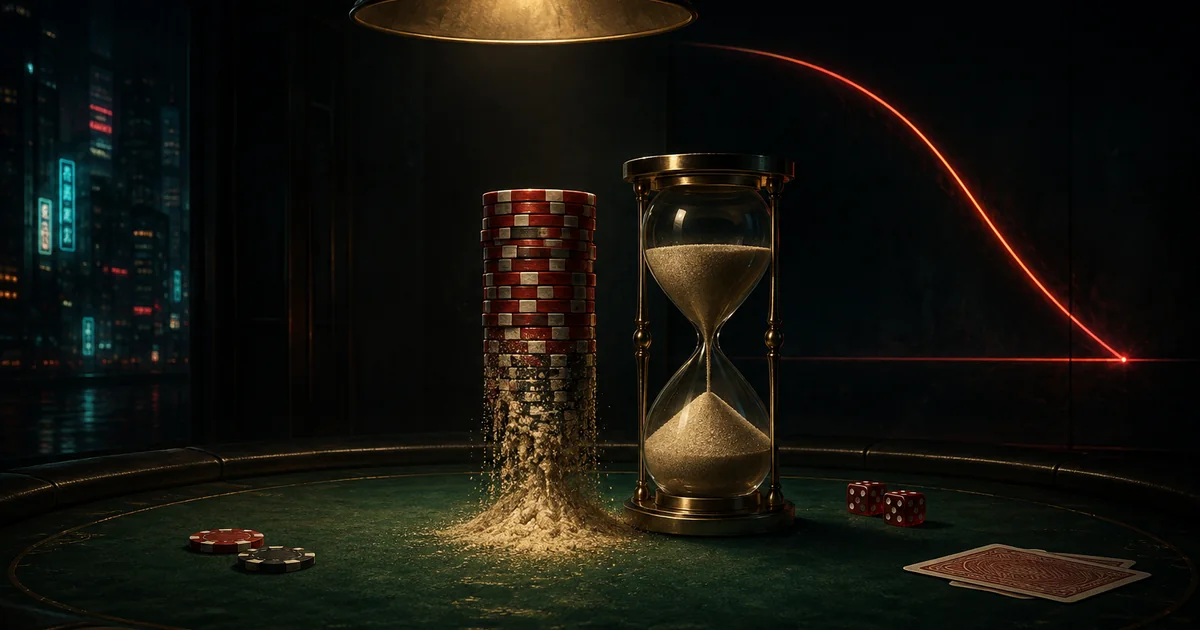


The missing four cents
A coin has two sides. Call it right and a fair game pays you double. Koban Flip pays ×1.96, and that four-cent gap is the entire business model, stated in the source with no ceremony.
On a single flip that is as cheap as gambling gets. You win half the time, you are paid 98% of fair value, and the expected return is 98 cents on the dollar. Compare that to a roulette wheel keeping 2.7% of every spin and Koban looks generous.
The catch is that Koban is not a single flip. It is a ladder, and ladders compound.
What the ladder actually pays
Each correct call multiplies your pot by 1.96 again. Ten rungs, ten multiplications. Against that, a fair coin would double each time — ×2, ×4, ×8, and so on to ×1,024. Here is the gap opening up:
| STRAIGHT CALLS | CHANCE | ENGINE PAYS | FAIR COIN | YOU GET |
|---|---|---|---|---|
| 1 | 1 in 2 | ×1.96 | ×2 | 98.00% |
| 2 | 1 in 4 | ×3.84 | ×4 | 96.04% |
| 3 | 1 in 8 | ×7.52 | ×8 | 94.00% |
| 4 | 1 in 16 | ×14.75 | ×16 | 92.19% |
| 5 | 1 in 32 | ×28.92 | ×32 | 90.38% |
| 6 | 1 in 64 | ×56.69 | ×64 | 88.58% |
| 7 | 1 in 128 | ×111.12 | ×128 | 86.81% |
| 8 | 1 in 256 | ×217.79 | ×256 | 85.07% |
| 9 | 1 in 512 | ×426.87 | ×512 | 83.37% |
| 10 | 1 in 1,024 | ×836.68 | ×1,024 | 81.71% |
The ladder is kobanLadder() in the engine, computed as 1.96 to the power of n and floored to two decimals. “You get” is the engine payout as a fraction of the fair one — 0.98 to the power of n.
The last column is the story. 0.98¹⁰ = 0.817. The two percent never changed; it just got applied ten times to a number that was doubling underneath it. By the top rung the house is keeping more than eighteen cents of every dollar of fair value, on a game whose headline number is two.
This is not a trick and nothing is hidden — the ladder is printed on screen before you place a coin. It is simply what exponentials do, and it is the single most useful thing to understand about every ride game ever built.
A detail worth respecting: the ladder is floored
There is a comment in the engine that says more about how a house should behave than any marketing page could.
Six of the ten rungs displayed a number one hundredth of a multiple higher than the server would actually pay. Nobody would have noticed and nobody would have been meaningfully poorer. The fix was made anyway, because a displayed ladder is a quote, and a quote that does not match the settlement is a small lie that compounds into a large distrust.
We mention it because it is the same principle the rest of this journal runs on: a published price you can audit beats a slogan, and the audit only means something if the numbers agree down to the last decimal.
The faces are already decided
One more thing the source makes explicit, and it reframes what a ride game is.
The whole streak — all ten faces — is determined when you buy the first coin. Cashing out early does not dodge a bad flip that had not happened yet; the flip was already there. Riding on does not tempt fate; fate was written before you sat down. What your decisions change is only how far along that fixed sequence you travel, and how much of the pot you are carrying when you stop.
That is exactly what makes the round verifiable after the fact: a sequence fixed in advance and committed by hash is a sequence you can recompute. A game that decided each flip as you called it would have nothing to prove.
What to do with this
The practical reading is not “never ride”. It is that riding has a price list, and the price list is the last column of that table.
- Decide the rung before the first flip, not during. The pull to continue arrives after a win, when the pot is largest and the next rung costs you the most in fair-value terms.
- Understand what depth costs. Going from rung five to rung ten multiplies your potential payout by roughly twenty-nine, and cuts your share of fair value from 90% to 82%. Both of those are true at once.
- Match the stake to the depth. A ten-rung plan is a 1-in-1,024 plan, and the sizing arithmetic in risk of ruin applies with unusual force to a game whose whole shape is long empty runs.
And the general lesson, which outlives this particular game: in any multiplying game, the advertised edge is the edge on one step. The edge on your plan is that number raised to the power of how many steps you intend to take. Two percent is small. Two percent, ten times over, is not.
The ladder, printed before you betKoban Flip: ten rungs at ×1.96 each, every face committed in advanceKoban Flip →
What is the house edge on Koban Flip?
2% per flip — a fair coin paid at ×1.96 instead of ×2, per KOBAN_WIN_100 = 196 in the engine. But the game is a ladder, so the cost compounds: at ten straight calls the payout is 81.71% of fair value, an 18.3% cost.
What does a ten-flip streak pay?
×836.68, against ×1,024 for a fair coin. The chance of getting there is 1 in 1,024. The ladder is computed as 1.96 to the power of n, floored to two decimals so the display matches what the server settles.
Why does a 2% edge become 18%?
Because the game multiplies. Each rung keeps 98% of fair value, and 0.98 raised to the tenth power is 0.817. The percentage never changed; it was applied ten times to a compounding number.
Can I improve my odds by choosing heads or tails?
No. Each face is an independent draw from the committed seed pair, and the whole sequence is fixed before your first call. Your decisions change how far you ride, not what the coins show.
Is cashing out early better than riding?
It is cheaper in fair-value terms — the shallower the rung, the less the compounding has taken. It is not free money either: every rung still returns 98% of the one below. What early cash-out buys is a smaller price and a smaller swing.
- Betkyo engine source: KOBAN_WIN_100 = 196, KOBAN_MAX_FLIPS = 10, kobanLadder() and deriveKobanFaces() in koban/derive.ts; the ladder figures and fair-value fractions are computed from those constants