
How a roll is made
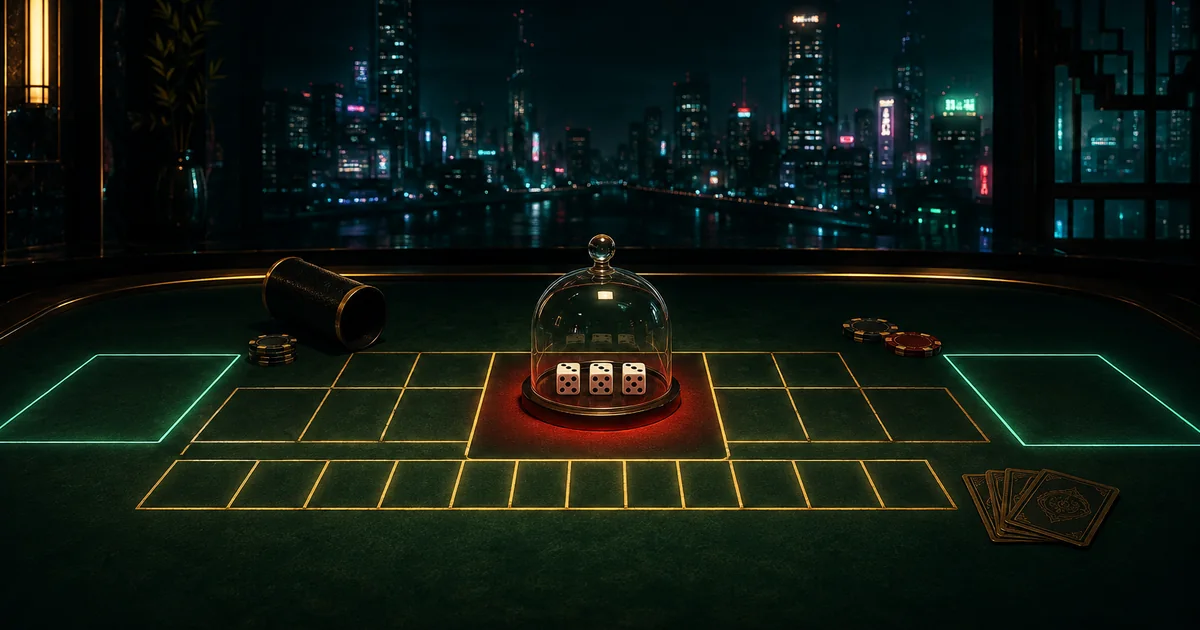
Sic Bo (大小, “big-small”) is three dice and a layout of boxes that bet on what they show. Everything below follows from one fact: each die is an independent, uniform draw from 1 to 6, so there are exactly 6 × 6 × 6 = 216 equally likely rolls. Count the rolls that win a box, multiply by what the box pays, divide by 216, and you have the return of that box to four decimal places. No simulation, no estimate.
One convention matters for reading the tables. The engine’s multipliers are total return — a ×2 bet gives back your stake plus one more, which most casinos would describe as “pays 1 to 1”. The ×181 on a specific triple is what a printed layout calls 180 to 1. Nothing is being inflated; it is the same number written the way the settlement code uses it.
The triple tax
Big wins on totals from 11 to 17, Small on totals from 4 to 10. Between them they cover every possible total, and the two ranges are mirror images, so each would win on exactly 108 of the 216 rolls — half — and at ×2 would return the stake in full. That is a fair coin, and a casino does not offer one.
The rule that fixes it is one line: both bets lose on any triple. There are six triples (1-1-1 through 6-6-6), three of them Small totals and three Big. Remove them and each bet wins on 105 rolls instead of 108. Six rolls in 216 is 2.78%, and that is the whole house edge on Big and Small. Odd and Even work the same way and carry the same tax.
| WINNING ROLLS | WIN CHANCE | PAYS | RETURN | HOUSE EDGE | |
|---|---|---|---|---|---|
| Without the triple rule (hypothetical) | 108 / 216 | 50.00% | ×2 | 100.00% | 0% |
| As the engine settles it | 105 / 216 | 48.61% | ×2 | 97.22% | 2.78% |
The six triples are 1.39% of Small’s range and 1.39% of Big’s; together they are the 2.78%.
This is unusually visible pricing. On most table games the edge is spread across a paytable and has to be computed; here it can be pointed at. The player who understands that Big and Small are a fair coin minus six named rolls understands the game.
Every box on the layout, priced
The same count works for every other box. The table lists each bet family with its winning rolls, the engine’s multiplier and the exact return. Totals are symmetric (a total of 4 has the same three rolls as a total of 17), so each row for a total covers its mirror.
| BET | WINNING ROLLS | PAYS (TOTAL) | RETURN | HOUSE EDGE |
|---|---|---|---|---|
| Big / Small / Odd / Even | 105 / 216 | ×2 | 97.22% | 2.78% |
| Combination (two named numbers) | 30 / 216 | ×7 | 97.22% | 2.78% |
| Single number (1, 2 or 3 dice show it) | 91 / 216 | ×2 / ×3 / ×4 | 92.13% | 7.87% |
| Total 7 or 14 | 15 / 216 | ×13 | 90.28% | 9.72% |
| Total 8 or 13 | 21 / 216 | ×9 | 87.50% | 12.50% |
| Total 10 or 11 | 27 / 216 | ×7 | 87.50% | 12.50% |
| Total 5 or 16 | 6 / 216 | ×31 | 86.11% | 13.89% |
| Any triple | 6 / 216 | ×31 | 86.11% | 13.89% |
| Total 4 or 17 | 3 / 216 | ×61 | 84.72% | 15.28% |
| Specific triple | 1 / 216 | ×181 | 83.80% | 16.20% |
| Total 6 or 15 | 10 / 216 | ×18 | 83.33% | 16.67% |
| Specific double | 16 / 216 | ×11 | 81.48% | 18.52% |
| Total 9 or 12 | 25 / 216 | ×7 | 81.02% | 18.98% |
A specific double pays when at least two dice show the number. The single-number return counts the three payout tiers: 75 rolls show the number once (×2), 15 show it twice (×3) and 1 shows it three times (×4).
What the shape tells you
Two things stand out once the boxes are lined up.
- The tax is not proportional to how hard the bet is. A specific triple is the longest shot on the table (1 in 216) and is priced at 16.2%, but a total of 9 — which hits more than eleven times as often — costs 19%. Rarity is not what sets the edge; the gap between the true odds and the round number printed on the felt is. Totals of 9 and 12 hit on 25 rolls and would need to pay ×8.64 to be fair; the layout says ×7.
- The cheap bets are the boring ones. Big, Small, Odd, Even and the two-number combination all sit at 2.78%. Everything that promises a bigger multiplier charges three to seven times as much for it. That is the general rule of casino paytables, and Sic Bo shows it on one felt: the multiplier is the price of the excitement, not a discount on it.
None of this makes the high boxes wrong to play. A ×31 on any triple is a real ride at a 2.78% chance, and a player who wants that shape should have it. The point is only that the price is knowable in advance, and here it is knowable from the source rather than from a brochure — the same argument this journal has made about blackjack’s 3:2 line and the ethics of stating the edge at all.
Three dice from the committed seed pair, and the full layout priced aboveSic Bo →
What is the best bet in Sic Bo?
Big, Small, Odd and Even, and the two-number combination bet. Each returns 97.22% for a house edge of 2.78%. No other box on the layout is cheaper.
Why do Big and Small lose on a triple?
Because that rule is the entire house edge. Big and Small each cover exactly half of the 216 rolls; removing the six triples takes each down to 105 winning rolls, which at ×2 is a 2.78% edge.
What does a specific triple pay, and what is the edge?
×181 total return (180 to 1). It hits on 1 roll in 216, so the return is 83.80% and the edge 16.20%.
Which Sic Bo bet has the highest house edge?
On this engine’s Macau-standard paytable, a total of 9 or 12 at ×7 (18.98% edge) and a specific double at ×11 (18.52%). Both hit far more often than a triple and are priced far worse.
Are the multipliers here the same as a casino’s “pays X to 1”?
They are the same amounts written as total return. ×2 is 1 to 1; ×31 is 30 to 1; ×181 is 180 to 1. The engine uses total return because that is what the settlement code multiplies the stake by.
- Betkyo engine source: the Sic Bo paytable, dice derivation and settlement in sicbo/derive.ts (multipliers stated as Macau-standard total-return)
- All win counts and returns in this article are an exhaustive enumeration of the 216 dice outcomes against sicboReturnX(); nothing is taken from a third-party odds table