
Two novelists
The first Japanese account of mahjong is a travel sketch. In 1909 Natsume Sōseki, already the country’s most famous novelist, toured Manchuria and Korea and wrote up the trip; among the things he describes seeing is a table of Chinese players moving small tiles about, a game he could not follow. Sets came back with travellers and students over the following decade, and by the early 1920s the game had a foothold among writers and the fashionable in Tokyo.
The second novelist did more than describe it. Kikuchi Kan, founder of the magazine Bungei Shunjū and the man who created the Akutagawa Prize, took up mahjong with the enthusiasm of a convert and put it in front of his readers. The first dedicated parlours opened in Tokyo around 1924, a rulebook and a federation followed at the end of the decade, and the game acquired the thing every craze needs, a vocabulary of its own that outsiders could not follow. It was, for a while, the pastime of the literary and the modern.
The rules Japan settled on diverged from the Chinese ones almost at once, and after the war the divergence became a style. Riichi, the declared ready hand, dora bonus tiles, and a scoring system built around yaku made Japanese mahjong its own game, and it is that version that the rest of the world now plays online under the name.
The parlour century
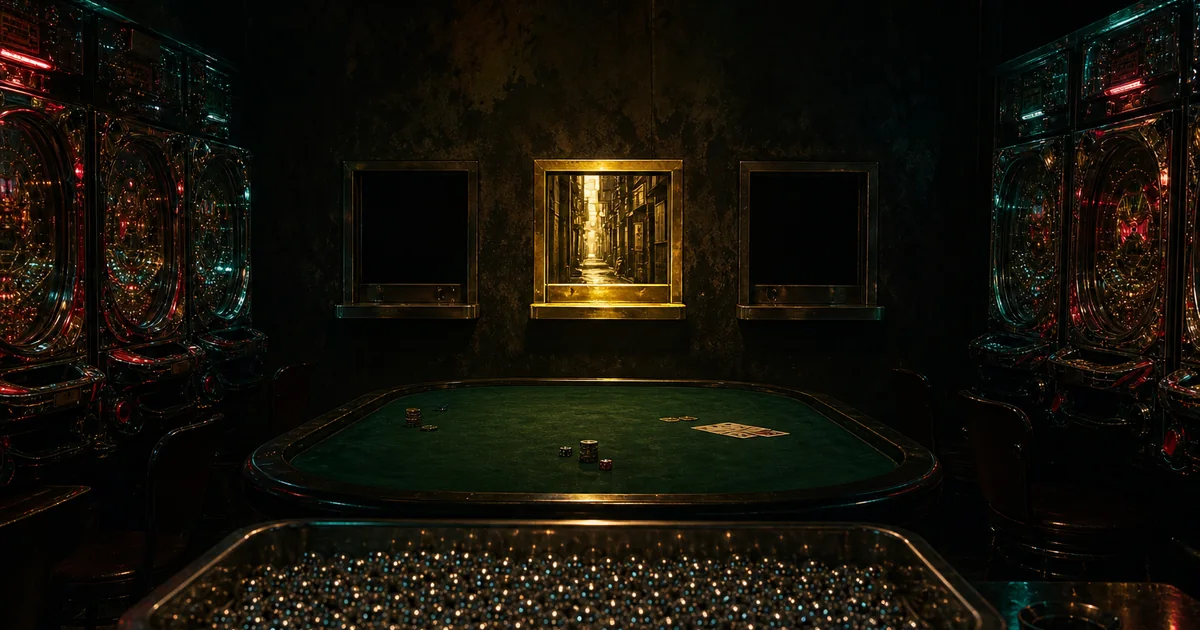
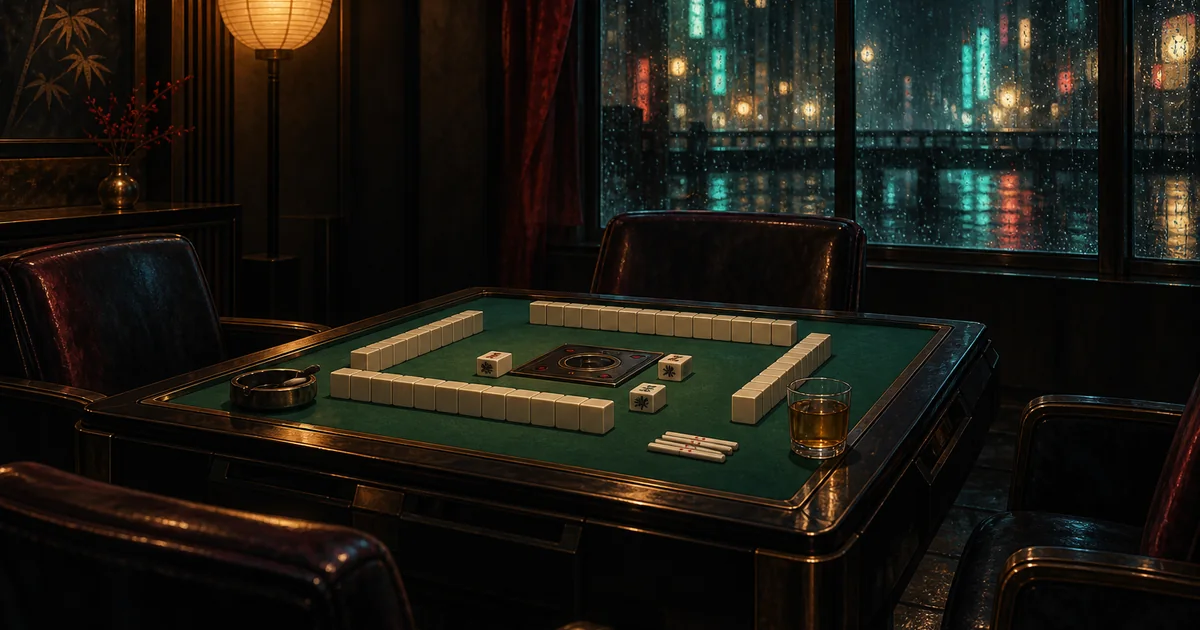
The mass boom was postwar. Through the 1950s and 1960s mahjong became the salaryman’s game, played after work in the jansō, the parlour that rents automatic tables by the hour. By the 1970s the number of parlours in Japan was counted in the tens of thousands, and the game had its own literature, most famously Asada Tetsuya’s Mahjong Hōrōki, a novel of the postwar gambling underworld whose hero is a tile hustler.
The parlour is where the grey zone lives. A jansō is licensed under the amusement business law as a place that provides tables and tiles; it is not licensed to host gambling, and a sign to that effect usually hangs somewhere on the wall. What happens at the tables is between the four players. For most of the century the arrangement has been that small stakes are nobody’s business and large ones are, and the line between the two is drawn by whoever is looking.
| YEAR | WHAT HAPPENED |
|---|---|
| 1909 | Natsume Sōseki describes the game after seeing it played in Manchuria |
| c. 1924 | The first mahjong parlours open in Tokyo; Kikuchi Kan champions the game |
| 1929 | A national mahjong federation is founded and rules are codified |
| 1950s–70s | The postwar boom: riichi rules, the salaryman’s game, tens of thousands of parlours |
| 2018 | M.League launches: a professional, televised, no-money competition league |
| 2020 | Tokyo’s chief prosecutor resigns over mahjong for money with reporters; fined in 2021 |
Momentary amusement
Article 185 of the Penal Code makes gambling a crime and then carves out one exception: it does not apply where the stake is “a thing provided for momentary amusement”. The phrase was written for a round of drinks or a meal, and the courts have read it narrowly; money, however little, is not a thing provided for momentary amusement, so a game of mahjong for a few hundred yen a point is, on the letter of the law, an offence. It is also, in practice, a thing millions of people have done without consequence, because the police have better uses for their afternoons.
The gap between the letter and the practice is usually invisible and occasionally not. In May 2020, during the pandemic’s state of emergency, the head of the Tokyo High Public Prosecutors Office was reported to have played mahjong for money with newspaper reporters; he resigned within days. Prosecutors initially declined to charge him, a citizens’ review panel found that decision inappropriate, and in 2021 he was fined by summary order. The stakes were small. The point was that the law he was paid to enforce did not contain an exception for small.
A grey zone is a rule that depends on who is looking. A published edge is a rule that does not.the difference, in two sentences
There is no mahjong on this site, and the reason is the same one that makes the parlour story worth telling. A game here is either offered, with a return computed from its engine and printed in the journal, or it is not offered. There is no version in which the table is legal and the money is a matter of interpretation. Pachinko solved the same problem with three shops and a prize counter; mahjong solved it by never quite asking. Both are answers to a law that punishes gambling and a public that wants to gamble, and neither is an answer a game with a stated house edge can give.
When did mahjong come to Japan?
In the first decade of the twentieth century; Natsume Sōseki described it in 1909 after seeing it played in Manchuria. The boom began around 1924, when the first Tokyo parlours opened and Kikuchi Kan championed the game.
Is mahjong for money legal in Japan?
No. Article 185 of the Penal Code punishes gambling and exempts only stakes that are “a thing provided for momentary amusement”, which courts have held excludes cash. Small-stake games are widely tolerated but occasionally prosecuted.
What is a jansō?
A mahjong parlour, licensed as an amusement business that rents tables and tiles. It is not permitted to host betting; what the players do among themselves is the grey zone.
What happened in 2020?
Tokyo’s chief prosecutor was reported to have played mahjong for money with reporters during the state of emergency and resigned. After a citizens’ review panel objected to the initial decision not to charge him, he was fined by summary order in 2021.
Is there mahjong on this site?
No. The site offers games whose return is computed from their engine and published; it does not offer a game whose legality depends on the size of the stake.
- Natsume Sōseki, Man-Kan tokorodokoro (1909), the travel sketches from Manchuria and Korea
- Penal Code of Japan, Article 185 (gambling; the “momentary amusement” exception)
- Reporting on the resignation of the Tokyo High Public Prosecutors Office chief, May 2020, and the 2021 summary fine (NHK, The Japan Times)
- Wikipedia (Japanese) — 麻雀: the game’s arrival, the 1920s boom and the postwar parlour era