
Cards that dodged the law
Playing cards reached Japan in the 1500s with Portuguese traders — the Japanese word karuta comes straight from the Portuguese carta. Card gambling spread fast enough that the shogunate banned the decks, then banned the redesigned decks that replaced them, then banned those too. Each ban produced a new deck that looked less like the last contraband.
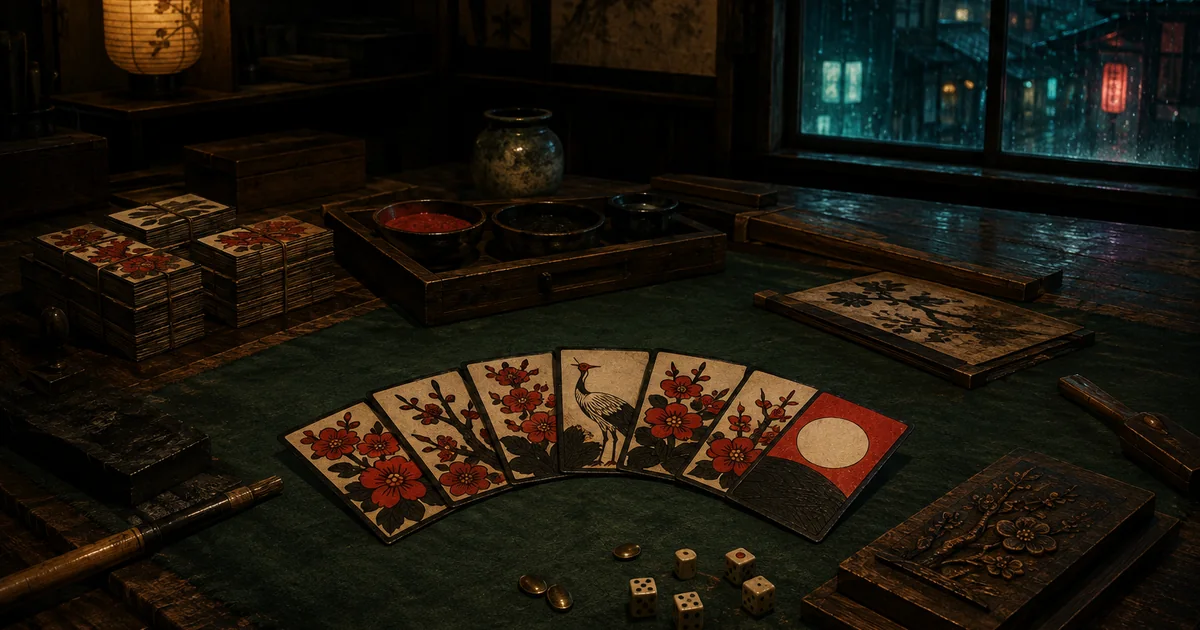
Hanafuda is the end of that evolutionary line: 48 cards with no numbers at all — twelve months, four cards each, identified only by flowers. Pine for January, plum for February, cherry blossom for March. Nothing on the face of a hanafuda card admits to being a gambling instrument, which was precisely the point. By the Meiji era the design had outlived the strictest bans and settled into the deck Japan still plays.
| MONTH | FLOWER | MONTH | FLOWER |
|---|---|---|---|
| January | Pine 松 | July | Bush clover 萩 |
| February | Plum 梅 | August | Susuki grass / moon 芒 |
| March | Cherry blossom 桜 | September | Chrysanthemum 菊 |
| April | Wisteria 藤 | October | Maple 紅葉 |
| May | Iris 菖蒲 | November | Willow / rain 柳 |
| June | Peony 牡丹 | December | Paulownia 桐 |
A Kyoto workshop, 1889
Fusajiro Yamauchi opened his card workshop — Nintendo Koppai — in Kyoto in 1889, hand-printing hanafuda on mulberry-bark paper. Business was good for an unglamorous reason: serious gambling parlors, including yakuza-run rooms, are widely said to have opened a fresh deck for every significant game to rule out marked cards. A deck a night, every night, is a printing company’s dream customer.
The underworld association runs deeper than clientele. The word yakuza itself is usually traced to a losing hand in oicho-kabu, a baccarat-like card game often played with hanafuda: 8-9-3 — ya-ku-sa — sums to 20, worth zero. “Yakuza” literally means a worthless hand; the gamblers wore the insult as a name.
In 1902 Nintendo added Western-style playing cards, and in 1959 it landed the deal that changed its scale: Disney-licensed cards, which moved the company from smoky parlors to family living rooms and sold in the millions. Flush with card money, Nintendo spent the 1960s trying nearly everything — instant rice, a taxi fleet, short-stay hotels — before a young engineer named Gunpei Yokoi and a line of toys pointed it toward what it became.
What hanafuda taught the house
There is a straight line from a fresh deck every game to a fresh seed pair every session. The parlors bought new cards because the integrity of the randomizer is the entire product — a marked deck isn’t a worse game, it is no game at all. Digital casinos inherit the same problem with worse optics: you cannot pick up a random number generator and feel its corners.
That is why our games publish a commitment to their randomness before you bet and let you recompute every result afterward. It is the fresh-deck ritual, made mathematical: nothing to palm, nothing to mark, and you don’t have to take the house’s word for it.
Hanafuda’s cousins live hereOmikuji, fukubukuro, koban — our originals borrow the same Japanese iconography. Try them free, no account needed.Omikuji →
Does Nintendo still sell hanafuda?
Yes. Nintendo still manufactures hanafuda in Japan, including premium lines and Mario-themed decks — a quiet acknowledgment of where the company came from.
Is koi-koi a gambling game?
Koi-koi is the most popular hanafuda game today: players capture cards to form scoring combinations (yaku) and choose whether to bank points or press on — that press-your-luck call is the “koi-koi”. Like any card game it can be played for stakes, but the game itself is a folk game taught to children.
Where does the word “yakuza” come from?
From oicho-kabu: the hand 8-9-3 (ya-ku-sa) totals 20, which counts as zero — the most worthless hand in the game. Gamblers adopted the term for themselves; the etymology is the standard account given in histories of the Japanese underworld.
- Hanafuda — deck structure and history
- Nintendo — founding era and pre-toy businesses
- Oicho-kabu and the ya-ku-sa etymology — standard account in histories of bakuto gambling culture