
What happened, and what did not
The account is that on a summer night in 1913, at one of the roulette tables in Monte Carlo, the ball settled on black twenty-six consecutive times. Word moved through the room as the run built. Players crowded the table and bet on red — then bet more on red, then more again — on the reasoning that a correction was overdue.
It was not. The wheel had no memory of the twenty-five spins before, and the twenty-sixth was exactly as likely to be black as the first. By the time the streak broke, a great deal of money had gone with it.
A caution about the story itself: the details have been retold for over a century and the precise figures vary between accounts. Treat the twenty-six as the traditional number rather than an audited one. The mathematics below does not depend on the anecdote being exact — it is the reasoning error that is the point, and that error is entirely ordinary.
The arithmetic of a streak
A European wheel has 37 pockets: eighteen red, eighteen black, one green zero. So black lands with probability 18/37, a little under half — the green pocket is the house edge made physical.
Twenty-six blacks in a row is (18/37) raised to the twenty-sixth power, which is about 1 in 137 million. Vanishingly unlikely for any particular sequence of twenty-six spins.
Now the part that dissolves the mystery. A busy casino floor spins its wheels tens of thousands of times a year, and Monte Carlo had been running for decades before 1913, alongside every other casino on earth. Across that many trials, a 1-in-137-million run is not a miracle; it is scheduled. The surprising thing would be a century of roulette with no famous streak in it at all.
| RUN | CHANCE |
|---|---|
| 5 in a row | about 1 in 38 |
| 10 in a row | about 1 in 1,400 |
| 15 in a row | about 1 in 54,000 |
| 20 in a row | about 1 in 2 million |
| 26 in a row | about 1 in 137 million |
The error was not the bet. It was the sizing.
Betting on red after twenty blacks is not, by itself, a mistake — it is a bet with the same expectation as any other bet on that wheel, which is to say slightly negative. Had the players simply kept betting the same amount, the night would be a footnote.
What made it ruinous is that the belief in a correction justified escalation. Each additional black felt like additional evidence, so the next bet got larger. That is the gambler’s fallacy fused to a martingale, and the combination is the most reliable way ever devised to convert a small edge against you into a total loss.
The trap is structural rather than psychological. Doubling after a loss wins a little, very often, and loses everything, rarely — and the rare branch is exactly the long streak the player has convinced themselves cannot continue. The strategy is a bet against the very thing that was happening in front of them.
Why the mistake survives
The intuition behind it is not stupid; it is a good instinct applied to the wrong object. Over enough spins the proportions really do converge toward half and half — that is the law of large numbers, and it is true.
The error is imagining that convergence works by compensation. It does not. It works by dilution: the existing imbalance is not repaid, it is swamped by the sheer volume of later spins. Twenty-six blacks are still twenty-six blacks a million spins later. They have simply stopped mattering.
Which is why the streak has outlived everyone who was in the room. It is the cleanest demonstration available that a random process has no obligations, no debts, and no sense of fairness — and that the money in a casino is usually lost to a belief rather than to a wheel.
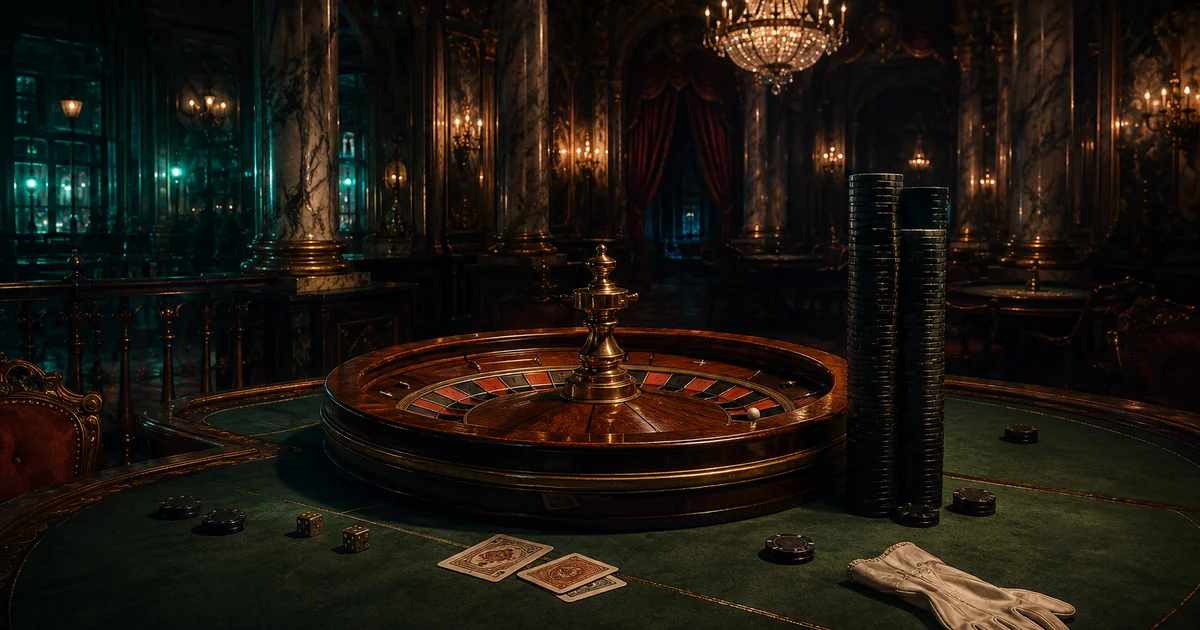
The wheel, without the folkloreWhere the edge actually sits on a European tableRoulette →
How unlikely is 26 blacks in a row?
On a European wheel it is (18/37)^26, roughly 1 in 137 million for any given run of 26 spins. Across every wheel that has ever spun, however, a streak like it was close to inevitable somewhere.
Was the Monte Carlo wheel rigged?
There is no evidence of it, and none is needed. The run is improbable for one particular sequence and unremarkable across the number of spins the world’s casinos have collectively made.
Was betting on red the mistake?
Not in itself — red carried the same slightly negative expectation as anything else on that wheel. The mistake was raising the stake each time on the belief that red was overdue, which turns a small disadvantage into a total loss when the streak continues.
Do streaks make the next spin more likely to correct?
No. Each spin is independent, and long-run balance comes from later results diluting the imbalance rather than from any correction of it. The past spins are never repaid.
- The 1913 Monte Carlo run is a long-retold account whose exact figures vary between tellings; the probabilities here are computed from a standard 37-pocket European wheel