
The problem a beacon solves
Per-player schemes like commit-reveal answer a private question: was my round honest? But some events need one draw that many parties must all trust at once — a lottery, a shared crash round, a leader election in a distributed system. Whoever generates that draw holds power over everyone else, and “trust our server” does not scale past one skeptic.
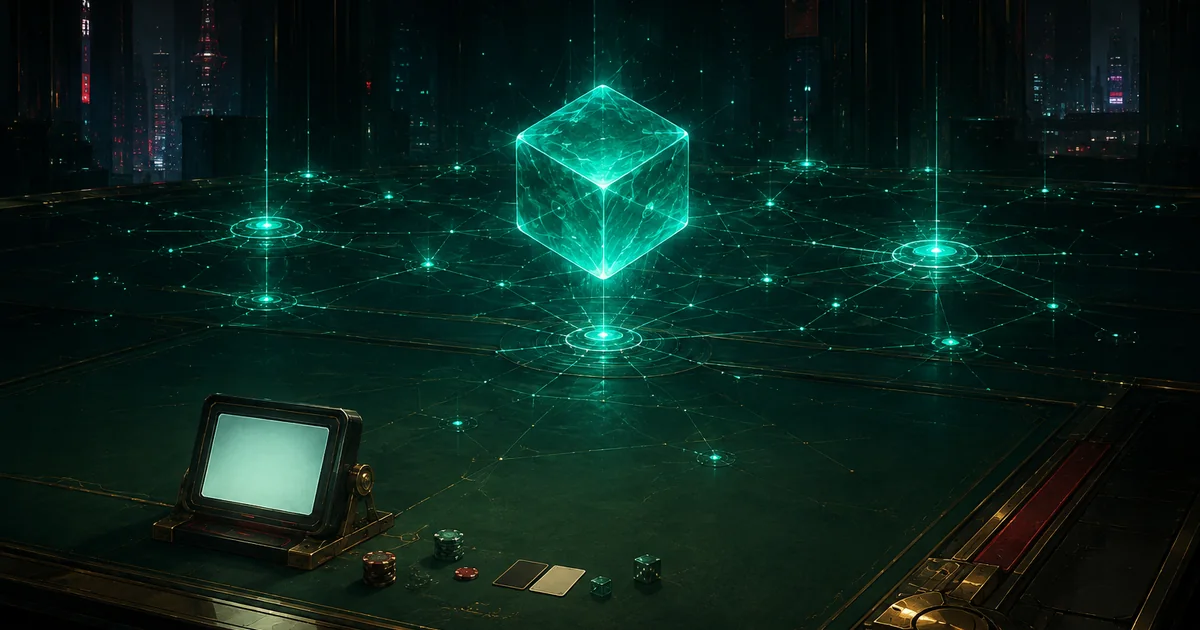
The beacon answer: make the generator a committee designed so that no member, and no small group of members, can predict or bend the output — then publish every draw for the world to verify. Randomness stops being a service someone provides and becomes a utility everyone shares, like time signals.
How a round works
- At setup, the members run a distributed key generation: a group public key is created, and each node receives only a *share* of the corresponding private key. The full private key never exists anywhere.
- Each round, every node signs the round number with its share, producing a partial signature.
- Any threshold of partial signatures — say, a majority — combines into the group’s single BLS signature for the round. Fewer than the threshold produces nothing at all.
- That signature is the round’s randomness. BLS signatures are deterministic: for a given round there is exactly one valid value, so nobody chooses it — yet it is unpredictable until enough members cooperate, because predicting it equals forging the group’s signature.
- Anyone, anywhere, verifies the value against the group public key and the round number. Verification is a signature check — no trust, no account, no permission.
The elegance is worth pausing on: the scheme has no random choices in it. The unpredictability comes entirely from the secrecy of key shares, and the fairness from determinism — one round, one possible value, provable by all. Rounds chain at a fixed cadence, timestamped and archived, so history is as checkable as the present.
Who runs it, who uses it
drand is operated by the League of Entropy, founded in 2019 by a mix of infrastructure companies, universities and research labs — the membership evolves, which is rather the point: the design assumes no permanent trusted operator, only that a threshold of independent institutions won’t collude. The best-known consumer is Filecoin, which draws its leader-election randomness from drand every epoch; lotteries, games and research systems tap the same feed.
For gambling, the fit is specific: beacons shine where many players share one draw — a raffle, a tournament seeding, a communal round. They are a poor fit for solo instant games: a fixed public cadence cannot price a player clicking five rolls a second, and a public value offers no per-player binding the way a client seed does. That is why our originals run commit-reveal per player, and why the four-scheme comparison treats beacons and seed pairs as complements, not rivals.
Crash is one round for every player watching — the natural home of beacon-style trust.Crash →
Can a drand member cheat?
A single member — or any group below the threshold — cannot predict, withhold meaningfully, or bias the output: partial signatures reveal nothing alone, and the combined value is the unique valid signature for the round. Cheating requires a colluding threshold of independent institutions, which is the explicit trust assumption.
If BLS signatures are deterministic, how is the output random?
Deterministic means uniquely determined by the key and the round — not knowable in advance. To anyone without a threshold of key shares, the upcoming signature is computationally indistinguishable from random until it is published. Determinism is what removes choice; secrecy is what preserves surprise.
Why doesn’t Betkyo just use drand for everything?
Cadence and binding. Solo games need a result per click, priced per player, with the player’s own seed in the mix — that is commit-reveal’s territory. Beacon-style randomness earns its keep where one draw must serve everyone at once, and the fairness page states the scheme per game rather than pretending one tool fits all.
- drand — documentation and specification
- League of Entropy — distributed randomness beacon consortium (2019)
- Boneh–Lynn–Shacham signatures — the deterministic signature scheme underlying each round
- Filecoin — drand as the network’s randomness source (protocol documentation)