
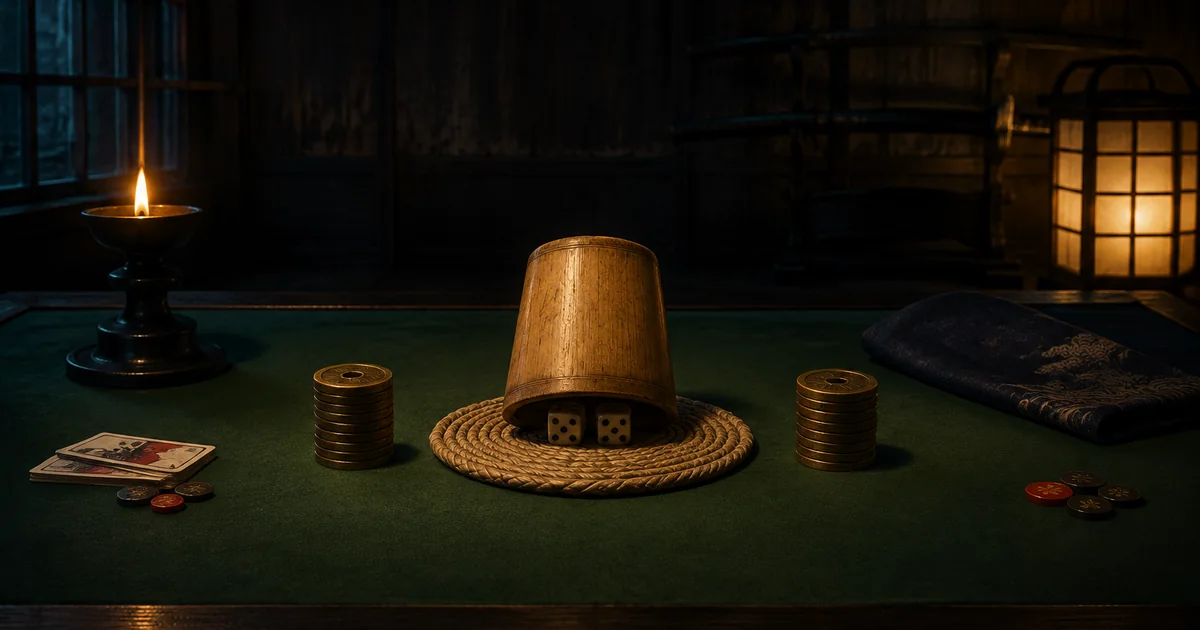
The scene everyone has seen
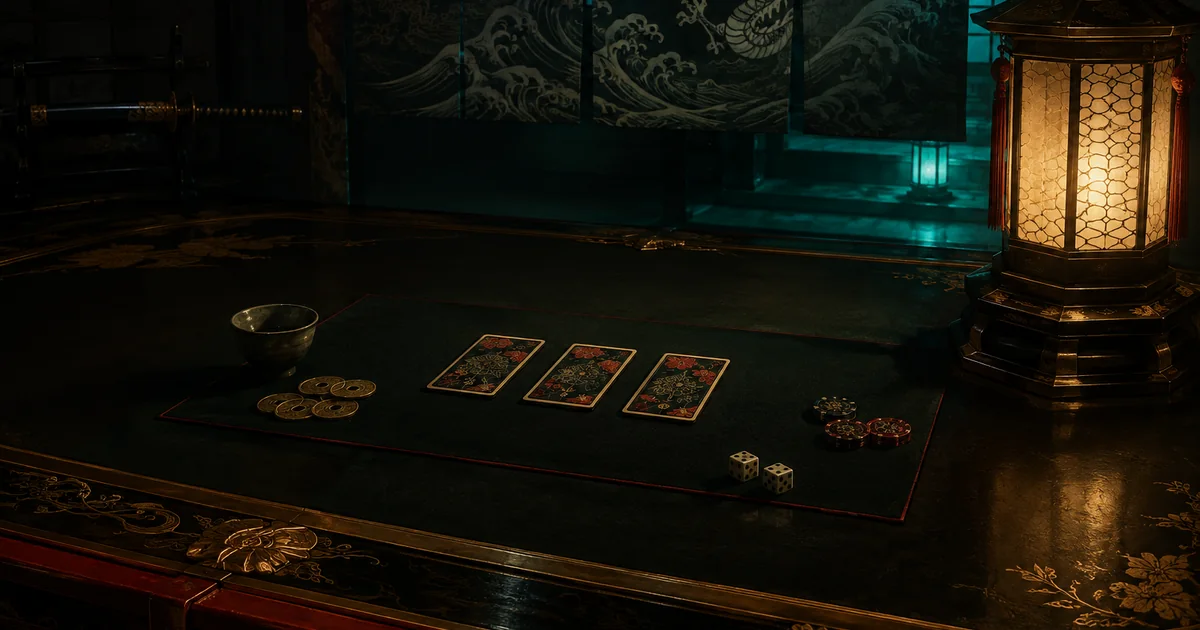
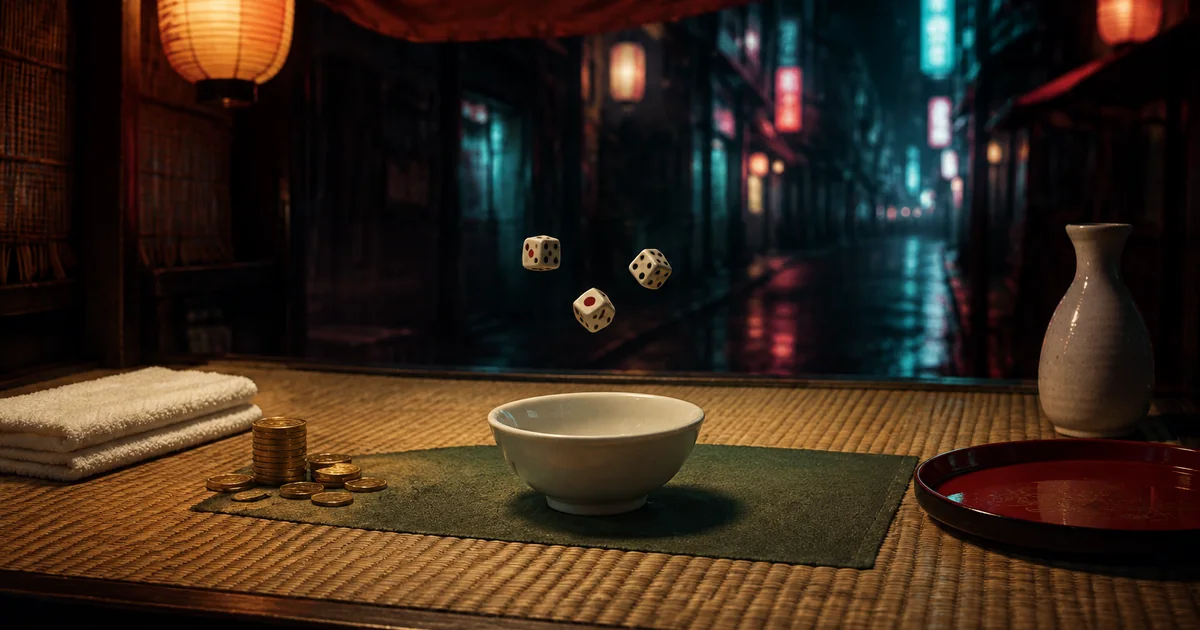
If you have watched any period drama set in old Japan, you have seen chō-han without necessarily catching its name. A back room, tatami, a kneeling circle of players. The dealer — the tsubofuri, the cup-shaker — raises a bamboo cup, rattles two dice inside it, and slams it mouth-down on the mat. Bets go down on either side of a line: 丁, even, or 半, odd. The cup lifts. Someone is paid by someone else, and the dice go back in the cup.
The theatrical details had jobs. The cup kept the result secret and settled before betting closed — a commitment device centuries before anyone hashed a seed. And the tsubofuri traditionally worked stripped to the waist, a display conventionally explained as proof of nothing hidden: no sleeve, no palmed die, the dealer’s own skin as the audit. The famous full-back tattoos of the era’s gambling clans made the gesture double as insignia — this table is run by us.
Those clans were the bakuto, the itinerant gamblers of the Edo period whose dice circuits ran through fairs, highway stations and temple grounds — and whose name survives less than their legacy does. One of their card games, oicho-kabu, donated its worst hand — 8-9-3, ya-ku-sa — to the Japanese language as the word for the organizations the bakuto became.
The mathematics of nothing up the sleeve
Two dice produce 36 equally likely ordered outcomes. Count the even sums: 2, 4, 6, 8, 10 and 12 arrive in 1+3+5+5+3+1 = 18 ways. The odd sums — 3, 5, 7, 9, 11 — arrive in 2+4+6+4+2 = 18 ways. Eighteen and eighteen. Chō and han are not approximately balanced; they are exactly balanced, and no amount of streak-watching or cup-reading changes it.
| SUM | WAYS | PARITY |
|---|---|---|
| 2 | 1 | even |
| 3 | 2 | odd |
| 4 | 3 | even |
| 5 | 4 | odd |
| 6 | 5 | even |
| 7 | 6 | odd |
| 8 | 5 | even |
| 9 | 4 | odd |
| 10 | 3 | even |
| 11 | 2 | odd |
| 12 | 1 | even |
Even: 18 of 36. Odd: 18 of 36. The most likely single sum, 7, is odd — the parity totals balance anyway.
Paid at even money, that is a game with an expected value of exactly zero for both sides — rarer in gambling history than it sounds. Nearly every house game ever devised buries its operator’s income in the odds: a 37th pocket, a shaved payout, a pushed tie. Chō-han’s odds contain no such thing. Whatever the bakuto earned, they earned somewhere else.
How the house ate: the cut, not the odds
The somewhere else was the tera-sen — literally “temple money”, a name usually traced to the temple and shrine grounds where games were often held. It was a commission: the house took an open percentage of winning bets, in plain view, as the price of the table, the cup, the enforcement and the discretion. Rates varied by era and operation; what mattered was the structure. The game was fair and the door was not free.
It is worth pausing on how different that is from the modern arrangement. A rake is visible — every player watches it leave the pot, can name it, can compare it across tables. An edge folded into the odds is invisible at the table: nothing is ever seen leaving, and the price surfaces only in the long-run arithmetic most players never do. The bakuto model was, in this one narrow sense, the more honest disclosure — the price of the game was a number you watched being charged.
It also explains the violence of the era’s gambling culture in economic terms. A house whose income is a cut of honest games has exactly one asset: the game’s integrity. Loaded dice did not just cheat a player; they destroyed the only thing the operation sold. The bakuto’s theatrical transparency — the bare-skinned dealer, the slammed cup — was not decoration. It was the business model defending itself.
The same bet, priced the modern way
Chō-han’s exact bet is alive on this site under another name. Our sic bo — the Macau dice game whose name, 大小, is literally “big-small” — offers odd and even on the sum of three dice at even money. Same wager, one die more, and one difference that carries the entire house edge.
That triple rule is the modern pricing model in miniature. No commission, no visible cut — just six specific rolls, about once every 36 throws, on which everyone loses to the house. The Edo player paid on the way out of a win; the modern player pays through a carve-out most never read. Both games are honest about their price in the sense that the price is published; they differ in where you have to look to see it.
And the cup itself has a descendant here too. Chinchiro — whose rules and odds we have covered — is the bowl-and-three-dice game the bakuto’s world evolved into at street level, and our version replaces the slammed cup with a committed hash: the result fixed before you bet, provable after. The tsubofuri’s bare skin was the best verification 1750 could offer. The seed pair is the same promise, made checkable.
Chō-han’s bet, three dice, priced in the openSic bo’s odd/even at even money — and the triple rule that is the whole house edgeSic Bo →
What is chō-han?
The classic dice game of Edo-period Japan: a dealer shakes two dice under a cup and players bet on whether the sum is even (chō) or odd (han), paid at even money. It was the signature game of the bakuto gambling clans.
Is chō-han a fair game?
In its odds, exactly fair: 18 of the 36 two-dice outcomes are even and 18 are odd, so both sides of an even-money bet have zero expected value. The operators profited by taking an open cut of winning bets — the tera-sen — rather than through the odds.
Why did the chō-han dealer play half-naked?
Tradition explains it as live proof of fairness: no sleeves, nothing palmed, the dealer’s skin as the audit. The full-back tattoos it displayed also marked whose table it was. The custom is the pre-cryptographic ancestor of showing your work.
Does any modern game offer chō-han’s bet?
Sic bo’s odd and even bets are the same wager on three dice. The difference is the price: both lose on any triple, six outcomes in 216, which gives the house its 2.78% — an edge chō-han’s two-dice version simply did not have.
- Chō-han — rules and cultural context
- Bakuto — the Edo-period gambling clans and the tera-sen
- Betkyo engine source: sic bo odd/even settlement and the triple carve-out in sicbo/derive.ts; the 97.22% figure is computed from those rules