
The bowl and the street
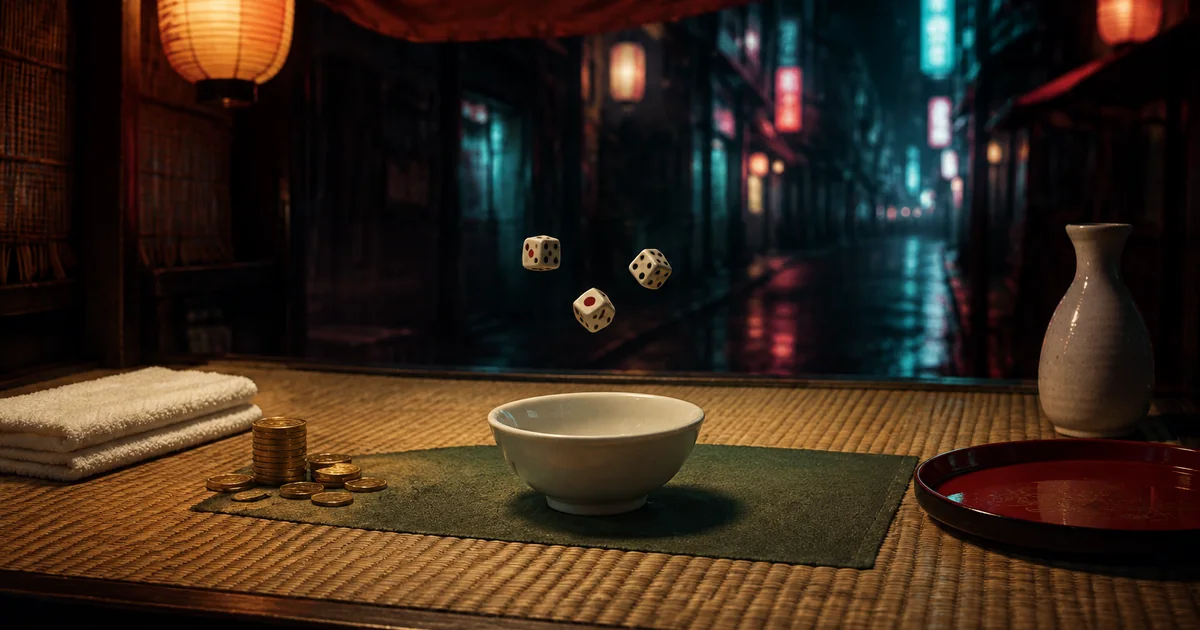
Chinchirorin (チンチロリン) — usually shortened to chinchiro — is the dice game of Japan’s back rooms. It spread through the early twentieth century among soldiers, dockworkers and itinerant laborers, and settled permanently into gambling-den folklore: three dice, a ceramic bowl, and money on the floorboards. The name is onomatopoeia — it is the sound the dice make ringing against the bowl.
The bowl is not decoration. A throw only counts if all three dice come to rest inside it; a die that bounces out is called ションベン (shonben — literally “piss”), and in street rules it costs you the throw or the whole hand. The bowl turns a dice game into a small physical skill and a big source of arguments, which is very much part of the appeal.
If you have seen chinchiro at all, it was probably in Kaiji, Nobuyuki Fukumoto’s gambling manga, where a rigged chinchiro game runs one of the story’s most famous arcs. The depiction is close to how the game is really played — hierarchy of hands, dealer rotation, instant wins and instant losses — minus the loaded dice, which we will get to.
Hand rankings, high to low
Every hand is three dice, thrown up to three times. The first throw that produces a ranked hand stands; three blank throws is a hand of nothing. From strongest to weakest:
| HAND | DICE | WHAT IT IS |
|---|---|---|
| ピンゾロ pinzoro | 1 · 1 · 1 | The top hand — triple ones |
| アラシ arashi | any other triple | “The storm” — 2·2·2 through 6·6·6 |
| シゴロ shigoro | 4 · 5 · 6 | Instant win in street rules |
| 目 point | pair + odd die | The odd die (1–6) is your point |
| 目なし me-nashi | no combination | Three throws, no hand |
| ヒフミ hifumi | 1 · 2 · 3 | Instant loss — the cursed straight |
Street games rank pinzoro above every arashi, arashi by its number, and points 6 down to 1. The two straights are the drama: 4·5·6 wins on the spot, 1·2·3 loses on the spot — and often pays a penalty on top.
How a round works here
Betkyo’s chinchiro is the classic dealer-versus-player duel. The dealer rolls first, up to three attempts. Dealer specials settle the round immediately — if the dealer lands pinzoro, arashi or shigoro, your stake is gone before you ever touch the dice. If the dealer rolls hifumi, you are paid without rolling. If the dealer lands nothing in three throws, the round is a push and your stake comes back.
Only when the dealer lands a point do you roll — and now every hand you can make has a price on it, measured against that point.
The exact payout table
These are not approximations from a strategy site. They are the settlement table of the engine that pays real rounds, quoted as total return per unit staked:
| YOUR HAND | RETURN | ENGINE VALUE |
|---|---|---|
| ピンゾロ 1·1·1 | ×6 | 600 |
| アラシ any triple | ×4 | 400 |
| シゴロ 4·5·6 | ×3 | 300 |
| Higher point than the dealer | ×2 | 200 |
| Tie or lower point | ×0 | 0 |
| ヒフミ 1·2·3 or no hand | ×0 | 0 |
Before you roll: dealer pinzoro/arashi/shigoro = you lose · dealer hifumi = you win ×3 · dealer no-hand = push.
Why the dealer wins ties
Chinchiro has no rake and no commission. The house edge lives entirely in two asymmetries: the dealer’s specials settle the round before you can answer them, and a tied point goes to the dealer. Both are traditional street rules — in a circle of players, the dealer’s advantage was the reason the dice (and the right to bank) rotated around the group.
That honesty matters more than it looks. A game whose edge is visible in the rules can be checked; a game whose edge hides in a shuffle or a payout rounding cannot. You can read our full odds on the table itself, and verify any settled round in the fairness panel.
Kaiji vs reality
The famous Kaiji arc turns on loaded dice — a set that only rolls 4, 5 and 6. It works in the story because street chinchiro has no way to audit a die beyond picking it up and feeling suspicious. That is the exact gap provably-fair systems close: in our version the three dice come from a committed seed pair, fixed before your bet, and every throw can be recomputed after the fact. A loaded die is not merely against the rules — it is mathematically impossible to hide.
Play Chinchiro free — no account neededSigned-out rounds run entirely in your browser, and every bowl verifies in the fairness panel.Chinchiro →
Is chinchiro the same game as cee-lo?
They are cousins. Cee-lo (四五六, “4-5-6”) is the Chinese-American branch of the same family: identical instant-win 4·5·6 and point mechanic, but usually played without a bowl and with different banking rules.
What does ションベン (shonben) mean?
Literally “piss” — a die that escapes the bowl. Street rules treat it as a fouled throw; harsher tables treat it as an instant loss. Digital chinchiro has no bowl physics, so the term survives only as flavor.
Was chinchiro legal in Japan?
Private dice gambling has been prohibited in Japan since the Meiji era, which is exactly why chinchiro lived in back rooms and fiction rather than casinos. The game itself — dice, bowl, rules — is simply a folk game; it is the wagering that the law regulated.
What is the best possible payout in Betkyo’s chinchiro?
A total return of ×6 on your stake: rolling pinzoro (1·1·1) against a dealer point. Dealer hifumi pays ×3 without you rolling at all.
- Nobuyuki Fukumoto, Tobaku Mokushiroku Kaiji (1996–) — the chinchiro arc
- Cee-lo — the Chinese-American branch of the 4-5-6 family
- Betkyo engine source: chinchiro settlement (resolve100), verifiable per round in the fairness panel