
One line in the chronicle
The Nihon Shoki, compiled in 720, is the official record of Japan’s early court. Its entry for the twelfth month of 689, the third year of Empress Jitō’s reign, contains a prohibition of sugoroku. No reason is given and no penalty is spelled out. It is the earliest gambling law in Japanese written history, and it is the kind of law that only gets written when the thing it forbids has already become a problem.
The same chronicle makes clear where the problem started. A few years earlier, in 685, it records Emperor Tenmu, Jitō’s husband and predecessor, summoning princes and ministers to the palace to play games of chance in front of the hall. Dice were a court pastime before they were a court concern, and the ban of 689 reads less like a moral awakening than an administrator’s reaction to what the pastime had become in the capital.
Later governments repeated the gesture for a thousand years. Bans on sugoroku and other dice games recur in Nara and Heian edicts, and the Tokugawa shogunate’s prohibitions on bakuchi, gambling generally, are the direct ancestors of the modern Penal Code articles. A ban that has to be reissued every century is a good measure of how little effect it had.
What the game was
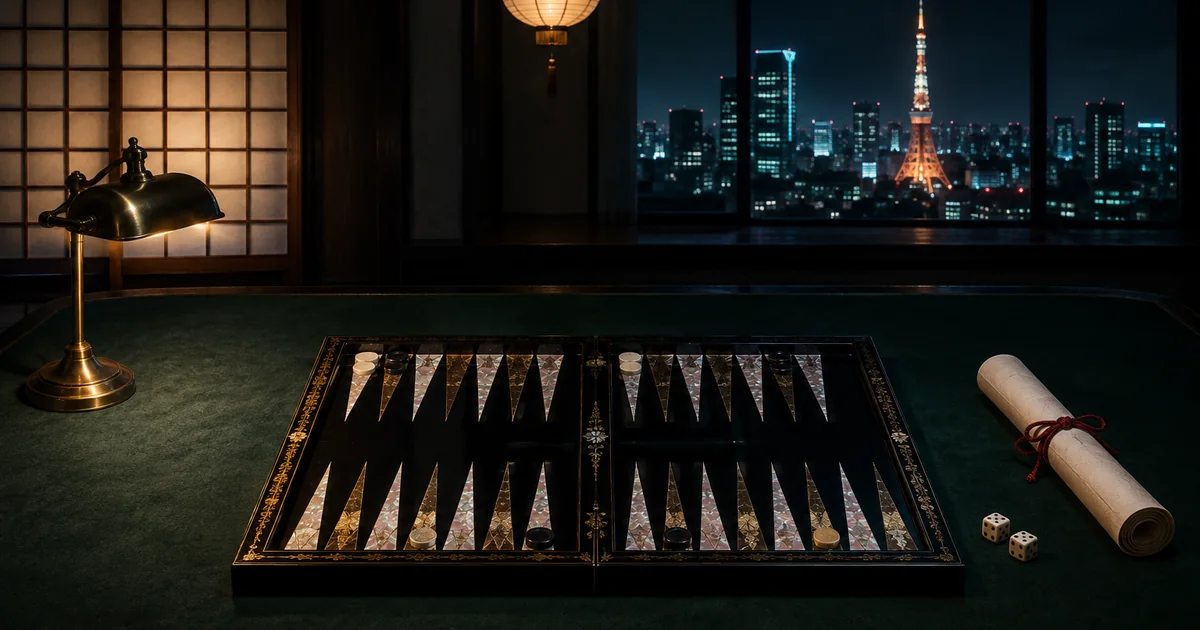
Sugoroku means “double six”, the name of the best throw, and the board game that carried it was the East Asian branch of the tables family that also produced backgammon and the Roman ludus duodecim scriptorum. Two players each moved fifteen pieces around a board of twenty-four points according to two dice, trying to bear all their pieces off before the opponent. The equipment was the same in kind as a backgammon set today: a board divided into two halves, wooden pieces, and a pair of cubic dice.
| GAME | WHERE AND WHEN | DICE | HOW IT IS DECIDED |
|---|---|---|---|
| Ban-sugoroku 盤双六 | Japan, by the 7th century to the Edo period | two | race of fifteen pieces a side around 24 points; bear off first |
| Backgammon | Europe, medieval to today | two | the same race, with the doubling cube added in the 20th century |
| E-sugoroku 絵双六 | Japan, Edo period to today | one | a single-track picture race; no choices, all dice |
| Chō-han 丁半 | Japan, Edo period | two | odd or even total under a cup; pure chance |
Ban-sugoroku and backgammon involve choice as well as dice, which is why they were bet on so heavily: a skilled player wins more often, and the loser can always tell himself he was unlucky.
Sets survive. The Shōsōin, the eighth-century imperial treasury at Nara, holds sugoroku boards and dice among its treasures, some of them inlaid work of the kind reserved for the court. The game in 689 was not a back-alley vice. It was played on lacquer by the people who wrote the ban.
The dice of sugoroku
By the Heian period sugoroku had become the standard gambling game of the aristocracy, and it turns up in the literature of the court as casually as cards do in a Victorian novel. It appears in The Tale of Genji and The Pillow Book, and the stakes were real: the twelfth-century tale collections are full of monks and courtiers who lost robes, horses and worse over a board.
The waters of the Kamo River, the dice of sugoroku, and the monks of the mountain: these are the things that do not obey me.attributed to Emperor Shirakawa (reigned 1073–1087, retired emperor until 1129), as recorded in the Heike Monogatari
Shirakawa’s three complaints are usually read as a joke about power, but the middle one is the sharpest. He had more control over the river and the warrior monks than anyone alive, and none over a pair of dice, and he knew the difference. He also could not check them. A die in 1100 was a piece of bone or wood whose fairness was a matter of trust in whoever brought it to the table, and the one thing a retired emperor could not buy was proof that the dice he had just lost to were honest.
Play not to lose
Around 1330 the monk Kenkō wrote down, in the miscellany known as Tsurezuregusa, a conversation with a man famous for his sugoroku. Asked for the secret of his play, the master gave a rule that has outlived the game it was about.
Do not play to win. Play not to lose. Ask which move will lose fastest, and avoid that one; then play the move that loses slowest, even if it is only by a single throw.Yoshida Kenkō, Tsurezuregusa, section 110 (paraphrased)
Kenkō generalised it at once to conduct and to governing a household, which is why the passage is quoted. But it is worth reading as the gambling advice it was. In a race game with dice, the throws are not yours; the only thing you control is how much of your position each throw can destroy. The master’s rule is to minimise that exposure first and pursue the win second. Seven centuries later the same rule comes out of the arithmetic: the Kelly criterion sizes a bet from the edge and returns zero when there is none, and risk of ruin is the formal name for the thing the master was avoiding one throw at a time.
Ban-sugoroku did not survive the advice. Through the Muromachi and Edo periods it faded while e-sugoroku, a picture race on a single track with no decisions at all, spread as a New Year’s game for families and children. By the nineteenth century the board game the empress had banned was effectively extinct in Japan, and when the tables family returned in the twentieth century it came back under its Western name, backgammon.
The dice today
The dice games on this site are descendants of the same pair of cubes, and the one difference that matters is the one Shirakawa lacked. Each die is not a physical object whose fairness you take on trust; it is a number derived from a server seed the house committed to in advance, your client seed and the round number, and any roll can be recomputed in your browser after the seed is revealed.
That does not make the dice obey anyone, which is the point. It makes them checkable, which is the thing thirteen centuries of bans, from Jitō’s single line to the Tokugawa edicts, never managed to provide. The verification walkthrough shows the check on a live round; chinchiro and chō-han are the two Japanese dice games that survived where ban-sugoroku did not.
What was Japan’s first gambling ban?
A prohibition of sugoroku recorded in the Nihon Shoki for the twelfth month of 689, during the reign of Empress Jitō. It is the earliest gambling law in Japanese written records; the chronicle gives no reason and no penalty.
What is ban-sugoroku?
A two-player race game of the backgammon family: fifteen pieces a side moved by two dice around a board of twenty-four points, with the aim of bearing off first. It reached Japan from the continent by the seventh century and died out in the Edo period.
Is ban-sugoroku the same as e-sugoroku?
No. E-sugoroku is a later picture race game on a single track, decided entirely by one die, played at New Year. It borrowed the name as the board game faded. Ban-sugoroku involved choices and was the game that was gambled on and banned.
What did Emperor Shirakawa say about sugoroku?
The Heike Monogatari attributes to him the remark that three things did not obey him: the waters of the Kamo River, the dice of sugoroku, and the warrior monks of Mount Hiei.
What is the sugoroku master’s advice in Tsurezuregusa?
Section 110 records a master saying that one should not play to win but play not to lose: identify the move that would lose fastest, avoid it, and prefer the move that loses slowest. Kenkō applied it to life generally; as bankroll advice it anticipates the modern arithmetic of minimising ruin.
How are dice generated on this site?
Each die is a uniform number derived from the committed server seed, your client seed, the round number and a cursor, mapped to 1 through 6. After the server seed is revealed, any roll can be recomputed in your browser.
- Wikipedia — Sugoroku: ban-sugoroku, e-sugoroku, the 689 prohibition and the game’s decline
- Wikipedia — Tsurezuregusa (Essays in Idleness): Kenkō’s miscellany, including section 110 on the sugoroku master
- Wikipedia — Emperor Shirakawa: the “three things” remark recorded in the Heike Monogatari
- Nihon Shoki, entries for Tenmu 14 (685) and Jitō 3 (689); Shōsōin treasury catalogues for surviving sugoroku boards
- Betkyo engine source: sicbo/derive.ts (per-die uniform derivation from the seed pair)