
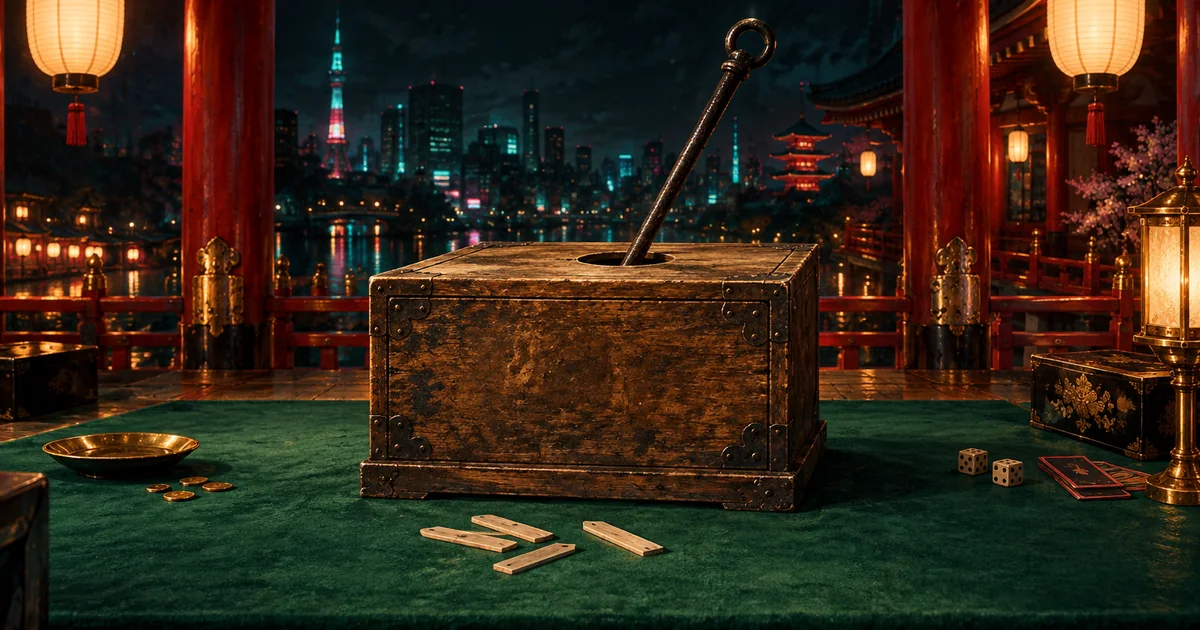
A monk with an awl
The first lotteries in Japan were not run by governments but by temples, and they did not begin as gambling. At Ryūanji, a temple at Minoo in the hills north of Osaka, the New Year drawing at the end of the sixteenth century chose a few worshippers to receive a protective amulet: everyone wrote their name on a slip, the slips went into a box, and a monk drew the winners with an awl. The prize was luck itself. Money came later, and once it came the form was set for two hundred years.
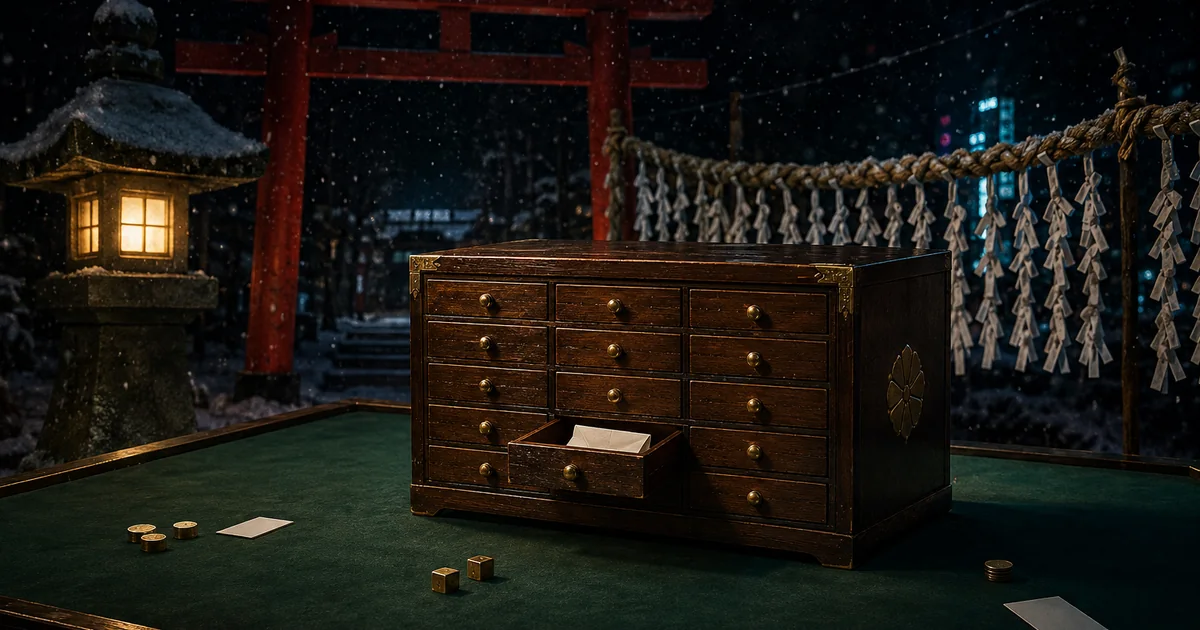
By the eighteenth century tomikuji, “fortune lots”, were a licensed way for temples and shrines to raise money for repairs. A buyer paid for a numbered wooden tag; on the drawing day the tags, or slips matching them, were tumbled in a large box on a stage in front of the crowd and a monk thrust a long awl through a hole in the lid. The number on the pierced tag won. In Edo the three great drawings, at Kan’ei-ji in Yanaka, the Fudō temple at Meguro and the Tenjin shrine at Yushima, drew crowds large enough to appear in rakugo, the comic storytelling of the period, where a poor man wins the tomi and cannot find the ticket.
The state tolerated tomikuji because the proceeds went to religious buildings and because the shogunate licensed the drawings, which is the same logic under which it later licensed nothing else. In the Tenpō reforms of 1842 the licence was withdrawn and tomikuji were banned along with much of the city’s public entertainment. Like the sugoroku ban of 689, the prohibition tells you how established the thing had become.
Nineteen forty-five
The lottery came back as a war measure. In July 1945 the government put a “victory ticket”, kachifuda, on sale to raise money for the war effort; the war ended before the drawing, and the tickets were paid out anyway. In October the same machinery issued the first government takarakuji, at ten yen a ticket with a top prize of a hundred thousand yen, and the money went to postwar reconstruction. A 1948 law, still the basis of the system, handed the right to issue lotteries to prefectures and the largest cities and fixed the two rules that still govern it: the proceeds fund local public works, and the prize money may not exceed half of what is sold.
That second rule is the whole economics of the lottery in one line. A ticket that returns at most fifty percent is not a game in the casino sense; it is a voluntary contribution with a prize attached, and the law says so by putting the cap in the statute rather than in the marketing. In practice the return has run a little under the cap, around 46% in recent years, with roughly 40% going to the issuing governments and the rest to sales and administration.
The prizes grew with the country. The Year-end Jumbo, the December drawing that has become a seasonal fixture, now pays ¥700 million for first prize and ¥150 million for the ticket on either side of it, so that a run of three consecutive tickets can be worth a billion yen. A ticket costs ¥300. Tickets are issued in units of twenty million, one hundred thousand numbers across two hundred groups, and each unit has one first prize, which is why the odds of holding it are about one in twenty million.
The price of a dream
| GAME | RETURN | WHERE THE FIGURE COMES FROM |
|---|---|---|
| Takarakuji (Year-end Jumbo) | under 50% by law; about 46% in practice | The 1948 lottery law’s cap and the issuers’ published accounts |
| Bingo on this site | about 96.5% | bingo/derive.ts header, one million simulated rounds |
| Keno on this site, any level | 98.65% to 99.07% | All forty KENO_PAYTABLE tables, cell × probability, summed |
The lottery figure is a statutory maximum and a reported average, not an engine constant. The two site figures are computed from engine source in the linked articles.
The gap is not a scandal, and it is worth being fair about why. The lottery is not trying to be a good bet. Its return is low because half of the money is meant to leave the game, and the buyer knows, or can know, that the ticket is mostly a donation with a very small chance of a very large prize. Nobody buys a Jumbo ticket for the expected value. They buy it for the week between purchase and drawing, during which a billion yen is possible, and ¥300 is a fair price for that week.
A casino game is a different product. Its return is high because the money is meant to circulate: the player is expected to bet many times, and a 3.5% edge on a bingo card compounds over an evening into the same kind of house share that a lottery takes in one bite. The keno article shows what the return does across forty tables, which is almost nothing, and what the volatility does, which is everything. That is the honest way to compare the two: not by the edge alone, but by how many times you are expected to pay it.
A lottery takes half of the money once. A casino takes a few percent of it many times. The player’s job is to know which one they are holding.the comparison, in two sentences
What the awl could not do
The tomi drawing was public for a reason. The box on the stage, the long awl, the monk’s theatrical thrust in front of the crowd: all of it was a fairness mechanism, the only one available in a world without mathematics for the purpose. The crowd could see that the box was shaken and the pick was blind. What it could not see was whether every tag was in the box, and stories of missing tags are as old as the drawings.
The modern lottery draws with a mechanical arrow machine in front of an audience and auditors, which is the same idea with better engineering. The games on this site do something the awl and the arrow cannot: they let the buyer check the draw afterwards. Omikuji, the site’s version of the shrine fortune, draws its tier from cursor 0 of a hash of a committed seed pair, and the tier can be recomputed by the player once the seed is revealed. There is no box to be short a tag, because the draw is a function of inputs the player partly supplied.
What is takarakuji?
Japan’s public lottery, issued by prefectures and designated cities under a 1948 law. Proceeds fund local government, and the law caps the prize pool at 50% of sales.
What was tomikuji?
The Edo-period temple lottery. Numbered wooden tags were tumbled in a box and pierced with an awl in front of a crowd; the proceeds paid for temple and shrine repairs. The shogunate banned it in 1842.
What are the odds of winning the Year-end Jumbo?
About one in 20 million per ticket for first prize. Tickets are issued in units of 20 million, one hundred thousand numbers across two hundred groups, with one first prize per unit.
How much of a lottery ticket is returned as prizes?
By law no more than 50% of sales; in practice around 46% in recent years, with roughly 40% going to the issuing governments and the rest to costs.
How does that compare with the games on this site?
Bingo returns about 96.5% and every keno table between 98.65% and 99.07%, both computed from engine source. The difference reflects the product: a lottery takes a large share once, a casino game a small share many times.
- Takarakuji official site (Japan Lottery Association) — history of takarakuji, prize structures and the distribution of sales
- 当せん金付証票法 (Act on Prize-Bearing Certificates, 1948) — the 50% prize cap and the issuing authorities
- Wikipedia (Japanese) — 富くじ: Ryūanji, the Edo drawings and the 1842 ban; 宝くじ: the 1945 issues and the Jumbo prizes
- Betkyo engine source: bingo/derive.ts, keno/paytable.ts, omikuji/derive.ts