
Ten hits, two cars and $5.6 million in cash
On 9 June 1998 the FBI arrested four people in Las Vegas and Modesto, California, and executed six search warrants, four in Las Vegas and two in Phoenix. The federal complaint unsealed that afternoon said the ring had been operating since September 1996 and that the Rio and the Luxor were among the casinos it had taken. It charged Dennis Nikrasch, 56, Eugene and Joan Bulgarino, 65 and 56, and Ronnie McElveen, 59, with conspiracy, interstate travel in aid of racketeering and interstate transportation of stolen property. By the end of the year the record ran to ten jackpots at six casinos, about $6 million, and a plea.
What makes the case unusual is how ordinary the wins looked. Nobody at the machine had done anything. The prosecutor, Gregory Damm, told the court that three of the Bulgarinos’ five children had won jackpots through the scheme: a son, $200,500 at the Excalibur in September 1996; a daughter, $3.7 million at Harrah’s in July 1997; another daughter, $1.7 million at the Luxor in November 1997. None of the three was charged. They had sat down at a machine and put coins in, and the machine had paid, exactly as the machine had been told to.
| ITEM | RECORD |
|---|---|
| Active | September 1996 to November 1997; six Las Vegas casinos hit ten times |
| Take | About $6 million in cash jackpots and cars, per the complaint and the prosecutor; “more than $6 million” at sentencing |
| Named hits | $200,500 Excalibur (Sept 1996); BMW at the Rio (24 May 1997, nominee took $30,000 instead); $3.7 million Harrah’s (July 1997); Jaguar at the Luxor (18 Oct 1997, sold in Phoenix for $57,000); $1.7 million Luxor (Nov 1997) |
| Method | A hand-held concealed device that programs the machine to win; unauthorised key; practice machine at the defendant’s home; a blocker against the cameras; nominee players recruited from Phoenix |
| Split | Nikrasch kept 50% to 70% of each jackpot, per court documents (he disputed this and said he had no money) |
| Goal at arrest | A Megabucks jackpot then over $17 million, and a move to France |
| Charges | Conspiracy, interstate travel in aid of racketeering, money laundering, interstate transportation of stolen property |
| Outcome | Nikrasch pleaded guilty 1 December 1998 and agreed to brief state and federal authorities; 7½ years. Eugene Bulgarino 3 years 10 months; Joan Bulgarino 4 months plus 4 months house arrest; McElveen 2 years 9 months |
Sources: Las Vegas Sun, 10 June 1998, 17 June 1998, 2 December 1998, 14 June 1999 and 23 July 1999; Associated Press via the Deseret News, 3 December 1998; Wired, 3 May 1999. The Sun’s June 1999 report dates the 7½-year sentence to December 1998; the plea hearing on 1 December had set sentencing for 5 March 1999.
It was his second time through the system. The first scheme ran from 1976 to 1979 on mechanical-reel machines, with keys, wires and magnets, and took about $10 million in cash and prizes including several cars. He was indicted in 1983, spent three years as a fugitive, surrendered in 1986 and was sentenced to 15 years; he served five and was paroled in January 1991. On parole he ran a jewellery store and worked part-time in the engineering department of a North Las Vegas casino. His parole was discharged in May 1996. The first rigged jackpot in the new scheme was paid in September 1996, four months later.
Under a minute at the cabinet
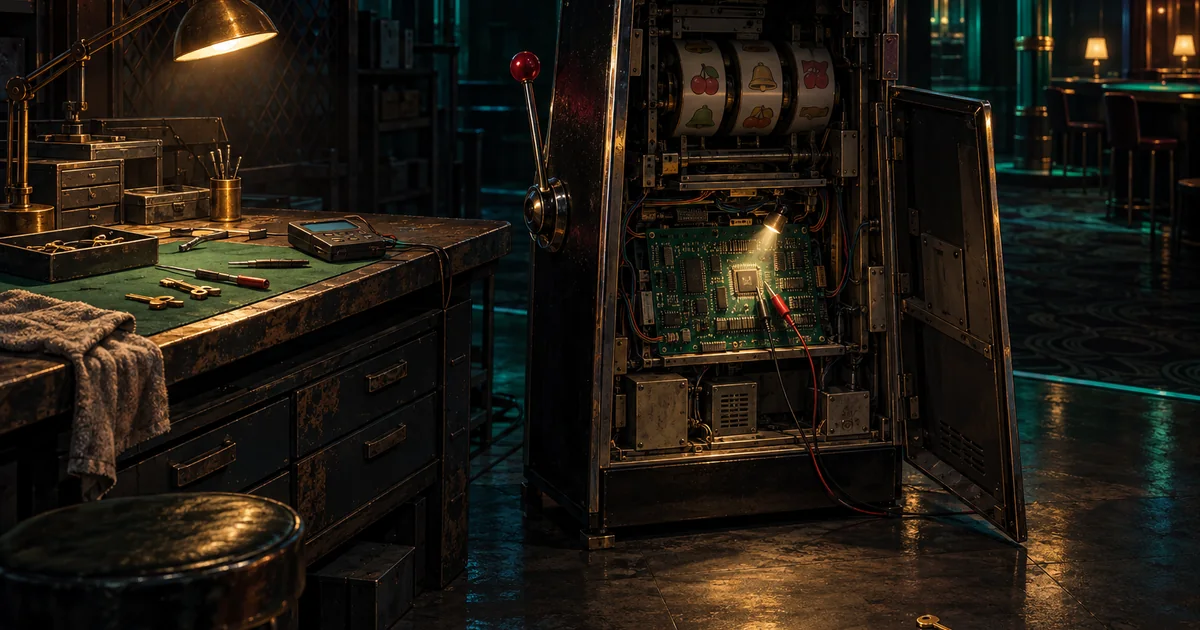
Between the two schemes the slot machine had changed from a mechanism into a computer. The reels on a 1990s machine were pictures; the result was chosen by a program on a chip inside the cabinet, and the pay table, the odds and the jackpot were lines in that program. Nikrasch, a locksmith by trade, read that change correctly. A lock and a chip are both things you can open if you have the key and have practised.
The complaint says he had a slot machine in his house and practised his tampering on it. In November 1997 two of his co-defendants travelled to the manufacturer’s Las Vegas facility to meet someone and obtain a computer chip; they failed, and one went back and got it. On the floor, the sequence reconstructed from the court record and the enforcement chief’s account is short. Choose a machine. A blocker stands between the cabinet and the ceiling cameras. Open the door with the key, open the housing around the chip, clip a lead to each side of it, and use the hand-held device to write the jackpot into it. Close it up. Under a minute. Walk out. Later a nominee, a friend recruited from Phoenix, sits down, plays a few coins, and the machine does what it has been told: it pays. “He would be in the casino a very short period of time,” the prosecutor said. “He would fix the machine, then leave. He wasn’t present when the jackpot was hit.”
Everything about that is designed around what the casino was watching for. Cameras look for a person doing something at the moment of the win; the person who did something had left an hour earlier. Surveillance looks for a device at the machine; the device was gone with him. The payout procedure checks the winner’s identification and the machine’s meters; the winner was a retiree with clean ID and the meters agreed with the chip, because the chip is what the meters read. The only thing out of place was the chip itself, and nobody looked at the chip. Keith Copher, chief of enforcement at the Nevada Gaming Control Board, said after the plea: “He had the most sophisticated system we’ve ever seen. We don’t know that he’s passed it along, and if he has, he’d better tell us.” Part of the plea deal was that he would tell.
What a rewritten chip is worth
A slot machine’s return is not a property of the cabinet or the reels. It is a property of the program: a weight for each symbol on each reel and a pay table, which together fix how much of every dollar the machine gives back over many spins. On our own Hanabi engine those numbers are public and the engine’s calibration header puts the return at 96.1% with a ×2,000 cap on any single round. An honest dollar spin on a machine like that costs the player about 4 cents in expectation, and the top prize is a rare event the weights price at a small fraction of a percent.
Now write to the chip. The weights no longer matter; the first coins will pay the top prize. The expected return on that one spin is not 96% but the prize divided by the stake: on a $1 spin at a ×2,000 cap, $2,000. On a machine whose top prize was $3.7 million, the first coins in were worth $3.7 million. The house edge did not shrink; it was replaced by whatever number the person with the clip leads chose, and the only remaining variables were how often he could do it and how long before someone opened the chip.
| QUANTITY | FIGURE | DERIVATION |
|---|---|---|
| Honest spin, 96.1% machine | −$0.039 per $1 | 1 − 0.961 |
| Rigged first spin, ×2,000 cap | +$1,999 per $1 | 2,000 − 1 |
| Average per hit | ≈ $600,000 | $6 million / 10 hits |
| Nikrasch’s share per hit | ≈ $300,000 to $420,000 | 50% to 70% of $600,000 |
| Largest single hit per minute at the cabinet | ≈ $3.7 million | Harrah’s, July 1997; the swap took under a minute |
| Per year of sentence | ≈ $800,000 | $6 million / 7.5 years |
| Both careers per year served | ≈ $1.3 million | ($10 million + $6 million) / (5 + 7.5 years) |
| Target at arrest | $17 million | Megabucks, February 1998 record |
The 96.1% return and ×2,000 cap are the Hanabi engine’s own calibration figures, used here as a representative modern machine; 1990s casino returns varied by denomination and property. The $6 million and the ten hits are the court figures; the split is the court documents’ range, which Nikrasch disputed.
Copher gave the Sun two numbers for the industry as a whole: slot cheating cost Nevada casinos about $40 million a year, and his division made close to 600 cheating-related arrests a year. Set against that, Nikrasch was arrested once in 22 years and took, by the state’s count, $16 million. The difference is where the attack lands. A light wand or a coin on a string, the attacks the Carmichael piece on this site covers, fools the machine about what happened at the coin path. A rewritten chip changes what the machine is.
A seed you can only commit to
Put the two slot cases on this site side by side. Ronald Harris was the regulator’s own engineer and modified chips he was paid to inspect, from the inside. Nikrasch was a locksmith with a practice machine and a manufacturer’s chip, from the outside. They attacked the same object by different doors: the program in the cabinet that decides the result. Everything the machine knew about its own odds lived on a chip behind a lock, so the odds belonged to whoever could open the lock, and the defence was a lock, a camera and an inspector, each of which turned out to be a person or a thing that could be got past.
A provably fair engine does not store its odds anywhere a locksmith could reach. The weight table is published. The server seed is committed by its hash before the bet; the player sets their own seed; the result of each reel stop is a function of those two seeds and a round counter. There is no cabinet to open because there is no cabinet, and there is no chip to write to because the thing that decides the result is not a stored program but a computation whose inputs the player holds half of. To make a machine like that pay a jackpot on the first spin, the house would have to publish a hash, take the bet, and then change the seed behind the hash, and the fingerprint the player already has would no longer match.
That is a claim about the result, not about everything. The honesty of the weight table as published, the custody of balances and the payment of a win are separate promises, and the Stake hack is the standing reminder that a committed seed covers the roll and not the vault. The narrow claim this case supports is the one Nikrasch’s whole method depended on: a game whose odds are a program in a box is only as fair as the lock on the box. A game whose odds are a commitment and a function has no box, and the 3.9 cents per dollar is the same on the first spin as on the millionth, for the retiree from Phoenix and for the man with the clip leads.
No cabinet, no chipEvery reel stop a weighted draw from a committed seed — the weights are public and the odds cannot be rewrittenHanabi →
Who was Dennis Nikrasch?
A Chicago-trained locksmith who became Nevada’s best-known slot cheat. He rigged mechanical-reel slots for about $10 million between 1976 and 1979 (indicted 1983, sentenced to 15 years in 1986, paroled January 1991), then from September 1996 ran a second scheme against computer-based machines that took about $6 million in ten jackpots before his arrest on 9 June 1998.
How did the 1990s scheme work?
He practised on a slot machine at home and obtained computer chips from the manufacturer. In the casino, with a blocker shielding him from cameras, he opened the machine with an unauthorised key, clipped a hand-held device onto the chip and programmed the machine to pay a jackpot, then left. A nominee player sat down later and won on the first coins; Nikrasch took 50% to 70% of the jackpot.
What were the biggest hits?
$3.7 million at Harrah’s in July 1997 and $1.7 million at the Luxor in November 1997, both won by relatives of a co-defendant, plus $200,500 at the Excalibur in September 1996, a BMW at the Rio and a Jaguar at the Luxor. At his arrest he was working toward a Megabucks jackpot of more than $17 million.
What was the sentence?
Nikrasch pleaded guilty on 1 December 1998 to conspiracy, interstate travel in aid of racketeering, money laundering and interstate transportation of stolen property, agreed to brief state and federal regulators on his method, and was sentenced to seven and a half years. His co-defendants received 3 years 10 months, 2 years 9 months, and 4 months plus house arrest.
Could a chip swap work against a provably fair slot?
No, because there is no stored program deciding the result. Each reel stop is a function of a server seed committed by its hash before the bet, the player’s own seed and a round counter, using a published weight table. Changing the outcome after the commitment would change the seed, and the fingerprint the player already holds would stop matching. What remains to trust is the commitment and the custody of funds, not a lock on a cabinet.
- Las Vegas Sun — “Scam allegedly won more than $6 million” (10 June 1998): the complaint, the four defendants and ages, the practice machine at home, the hand-held device, the November 1997 trip to IGT’s facility for a chip, the BMW at the Rio ($30,000) and the Jaguar at the Luxor ($57,000), the six search warrants
- Las Vegas Sun — “Prosecutor: Slot cheat was trying to hit Megabucks jackpot” (17 June 1998): the $6 million figure, the $17 million Megabucks goal and France, the 15-year 1986 sentence, parole January 1991 and discharge May 1996, the $200,500, $3.7 million and $1.7 million jackpots and who won them
- Las Vegas Sun — “Slot cheat who won millions to tell all to Nevada gambling authorities” (2 December 1998): the plea, the blocker, the Phoenix nominees, the 50–70% split, six casinos ten times, Keith Copher’s quotes, $40 million a year and about 600 arrests
- Las Vegas Sun — “Couple in slot-cheat ring draw prison time” (14 June 1999): the four sentences, the “computer expert who actually opens the slot machines” description, the McAndrew alias
- Las Vegas Sun — “Six Vegas residents arrested in alleged slot scam” (23 July 1999): the sentences restated; the separate 1999 ring that included Tommy Carmichael
- Associated Press via the Deseret News — “Slot machine cheater may spill the beans” (3 December 1998): the $16 million over 22 years figure, the 1976–79 scheme, the plea and cooperation
- Wired — Vince Beiser, “Silicon Crackers Tackle Casinos” (3 May 1999): the 7½-year sentence, the $6 million, “the most sophisticated cheat we’ve seen”, the $40 million-a-year estimate
- Las Vegas Advisor — Question of the Day (30 September 2013): the keys-wires-magnets method of the 1970s, the 1983 indictment and 1986 surrender, the chip clips and the under-a-minute swap, the Black Book listing
- Betkyo engine source: hanabi/engine.ts (HANABI_SYMBOLS weights, calibration header, HANABI_WIN_CAP100), _shared/seedApi.ts and _shared/demoLocal.ts (HMAC-SHA256 per draw from the committed server seed, client seed and nonce)
- Calculation for this article: honest spin 1 − 0.961 = −$0.039 per $1; rigged first spin at the ×2,000 cap 2,000 − 1 = +$1,999 per $1; $6 million / 10 hits ≈ $600,000; 50–70% of that ≈ $300,000–420,000; $6 million / 7.5 years ≈ $800,000 per year; ($10 million + $6 million) / 12.5 years ≈ $1.3 million per year served