
The whole game is one fraction
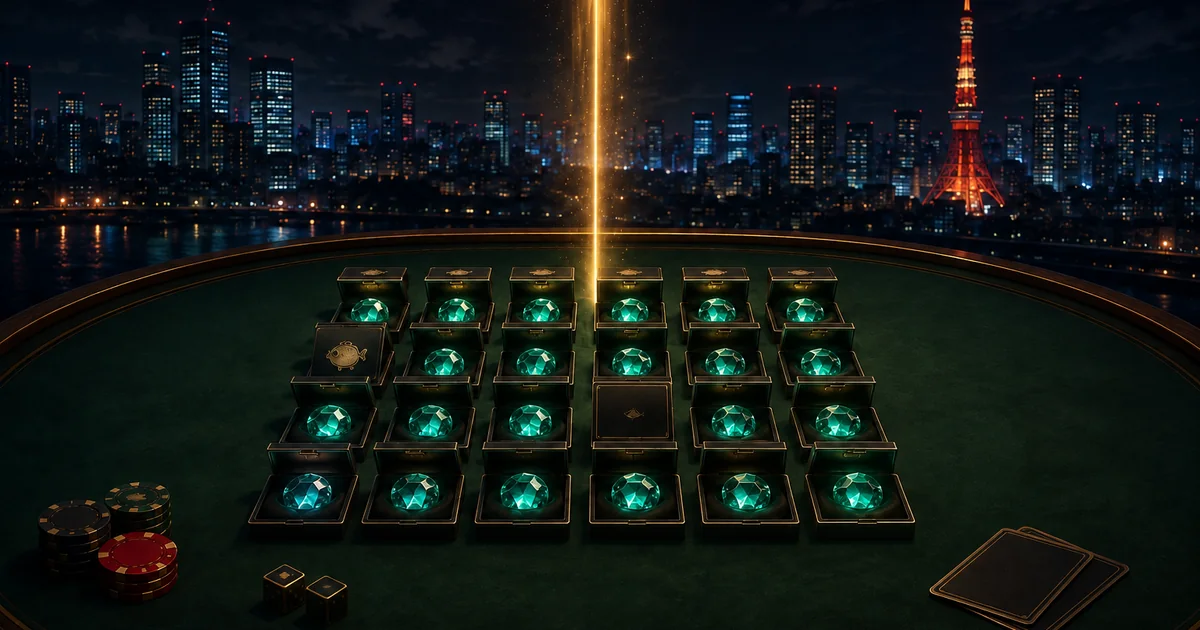
Fugu is a minefield: twenty-five tiles, some number of them hiding a fish, and a multiplier that climbs with every safe tile you turn over. The multiplier looks like it was designed by hand. It was not. It is a single fraction, and the engine prints it.
That fraction is just the inverse of a probability. The chance that your first k picks are all safe, with m mines among 25 tiles, is the product of (safe tiles left) ÷ (tiles left) at each step — and the engine’s fraction is exactly that product turned upside down. So the multiplier on any tile is 1 ÷ (probability of having reached it), × 0.99.
Write it that way and the two things people find surprising about Fugu both fall out immediately.
Why ten mines pays the same as fifteen
Clearing the whole board means revealing every safe tile, and the chance of doing that is 1 over the number of distinct ways the mines could have been laid out: 1 ÷ C(25, m). So the full-clear payout is C(25, m) × 0.99, and binomial coefficients are symmetric — choosing which 10 tiles hold mines is the same count as choosing which 15 do not.
| MINES | SAFE TILES TO CLEAR | FULL-CLEAR ODDS | FAIR PAYOUT | ENGINE PAYS |
|---|---|---|---|---|
| 1 | 24 | 1 in 25 | ×25 | ×24.75 |
| 2 | 23 | 1 in 300 | ×300 | ×297.00 |
| 3 | 22 | 1 in 2,300 | ×2,300 | ×2,277.00 |
| 5 | 20 | 1 in 53,130 | ×53,130 | ×52,598.70 |
| 10 | 15 | 1 in 3,268,760 | ×3,268,760 | ×3,236,072.40 |
| 15 | 10 | 1 in 3,268,760 | ×3,268,760 | ×3,236,072.40 |
| 20 | 5 | 1 in 53,130 | ×53,130 | ×52,598.70 |
| 24 | 1 | 1 in 25 | ×25 | ×24.75 |
Read the table top-down and bottom-up: it is the same column of numbers. Ten mines and fifteen mines are mirror images, as are five and twenty, one and twenty-four.
So the largest number the site can display — ×3,236,072.40 — belongs to two different boards at once, and it is not the hardest board. Twelve or thirteen mines would pay more (C(25,12) = C(25,13) = 5,200,300), but those are not selectable, and the guide is explicit that the payout is bounded by the table’s maximum profit long before any of these figures. The full-clear number is a property of the formula, not a prize anyone has collected.
The other end of the ladder
The same fraction sets the price of the very first tile, and here the mine count does the opposite of what the full-clear table suggests: more mines, bigger first step.
| MINES | CHANCE FIRST PICK IS SAFE | ENGINE PAYS |
|---|---|---|
| 1 | 96.0% | ×1.02 |
| 3 | 88.0% | ×1.11 |
| 5 | 80.0% | ×1.23 |
| 10 | 60.0% | ×1.64 |
| 15 | 40.0% | ×2.47 |
| 20 | 20.0% | ×4.95 |
| 24 | 4.0% | ×24.75 |
With 24 mines there is exactly one safe tile, so the first pick is the full clear — and the row matches the top table, as it must.
One mine is a slow ladder that almost never ends early; twenty-four mines is a single 1-in-25 draw dressed as a minefield. The board looks the same in both cases. The fraction does not.
What every pick costs
Here is the part worth carrying out of the article. If the multiplier is 0.99 divided by the probability of getting there, then the expected value of cashing out at any tile is probability × (0.99 ÷ probability) = 0.99. Every tile. Every mine count. Cash out after one pick or after twenty, on a one-mine board or a twenty-mine board, and the average return is 99 cents on the dollar.
That is the same flat price Limbo charges at every target, and the opposite of what Koban’s ladder does — there the fee compounds per rung because each rung is priced separately at ×1.96. Fugu prices the whole path once, from the odds, so riding deeper does not raise the fee. It raises the variance, and only the variance.
So the honest way to read the mine selector is not “which board pays best” — they all pay the same — but “how much of my stake do I want riding on each tile”. A low mine count is many small steps; a high one is a few violent ones. The sizing arithmetic in risk of ruin is the whole decision, and the engine’s fraction is what makes it a clean one.
The 5×5 board and its one fractionFugu: pick a mine count, turn tiles, and check the ladder against the formula aboveFugu →
What is the highest multiplier in Fugu?
×3,236,072.40 on screen, for clearing all safe tiles with ten or fifteen mines — C(25,10) × 0.99. It is a property of the formula rather than a paid prize: the guide states that payouts are bounded by the table’s maximum profit.
Why do ten mines and fifteen mines pay the same?
Because the full-clear payout is the number of ways to place the mines, C(25, m), times 0.99 — and C(25,10) equals C(25,15). The same symmetry pairs 5 with 20 and 1 with 24.
Which mine count has the best odds?
None. The multiplier is 0.99 divided by the probability of reaching each tile, so the expected return of cashing out anywhere is 99% on every board. The mine count changes how the ride feels, not what it costs.
How is the Fugu multiplier calculated?
As one exact fraction — the product of (tiles left) over the product of (safe tiles left) across every tile revealed — floored to two decimals, times the table’s return factor (0.99 by default), floored again. The engine computes the products in BigInt because they overflow ordinary numbers.
- Betkyo engine source: MINES_CELLS and minesMultiplier() in mines/minesApi.ts; the default return factor of 0.99 in _shared/coinGame.ts. Every figure in the tables is that function evaluated, not a published paytable
- Binomial coefficients and their symmetry C(n,k) = C(n,n−k) — standard in any combinatorics text