
The flaw was in the printing
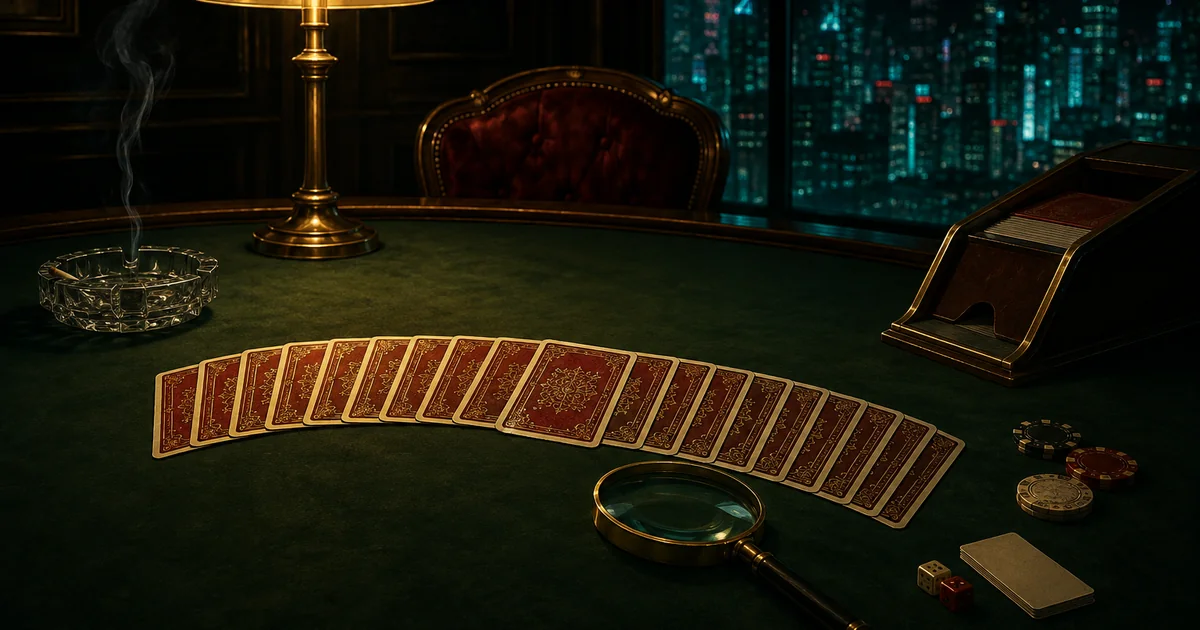
A playing card is supposed to be symmetric. Turn it 180° and the back should look identical, because if it does not, the back carries information about the front. Card manufacturers know this, and most decks are cut precisely enough that no one can tell. Some are not. On the Gemaco decks used at Crockfords in 2012 the diamond pattern ran slightly closer to one long edge than the other — a difference of a fraction of a millimetre, invisible in play unless you were looking for it.
On its own that flaw is useless. Every card in a fresh deck is oriented at random, so the edges tell you nothing. Edge sorting is the work of turning a random orientation into a sorted one, and the person who does that work is the dealer.
The method: a superstition, a shuffler, and a pair of eyes
Ivey played punto banco, the casino form of baccarat in which the player makes no decisions at all beyond which side to back. That is the point: nobody suspects an edge in a game with no strategy. The edge came from three requests, each of which sounded like a high roller’s whim.
- Rotate certain cards. Cheung Yin Sun, sitting beside Ivey, asked the croupier to turn particular cards — the sevens, eights and nines that decide punto banco — through 180° before they were placed in the discard, explaining that the pair were superstitious. The croupier obliged. After a shoe or two, every high card in the deck faced one way and every low card the other.
- Keep the same decks. Ivey asked that the decks be reused rather than replaced, and that they be shuffled by the automatic machine rather than by hand. A machine shuffle randomises the order of the cards but does not turn any of them over. The sort survived the shuffle.
- Read the edge before the turn. From then on, the first card out of the shoe told Ivey whether it was high or low before it was dealt. In punto banco that is enough to choose the right side far more often than chance.
Over two days in August 2012 he won £7.7 million. Nothing was marked, nothing was touched, and no rule of the game was broken at the table. The casino examined the play afterwards, understood what had happened, wired back his £1 million stake and declined to pay the rest.
What Mr Ivey did was to stage a carefully planned and executed sting.Lord Hughes, Ivey v Genting Casinos (UK) Ltd t/a Crockfords [2017] UKSC 67
Three courts, one answer
Ivey sued for his winnings, and his argument was simple and, on its face, reasonable. He had not touched the cards. He had made requests any player may make and the casino had granted them. He believed, sincerely, that he was an advantage player using legitimate skill, the way a card counter does. If cheating requires dishonesty, and he was not dishonest, then he had not cheated.
| DATE | COURT | RESULT |
|---|---|---|
| 8 October 2014 | High Court | Edge sorting was cheating within the meaning of the Gambling Act 2005; claim dismissed |
| 3 November 2016 | Court of Appeal | Appeal dismissed, 2–1 |
| 25 October 2017 | Supreme Court | Appeal dismissed unanimously; the conduct was cheating and dishonesty is not a separate requirement |
Every court rejected the argument, and the Supreme Court explained why in terms that go beyond casinos. Cheating, it held, does not require dishonesty as an ingredient: a runner who trips an opponent has cheated whatever he tells himself. What Ivey did was not observation of a flaw the casino had left open, like counting cards from a real shoe. He had caused the croupier to sort the deck for him, under a false pretext, so that the game he then played was not the game the casino thought it was offering. The court called it a sting.
The judgment is better known among lawyers for what it did next. Having decided the case, the court went on to say that the long-standing English test for dishonesty — the two-stage Ghosh test, which asked whether the defendant himself realised that ordinary people would think his conduct dishonest — was wrong, and replaced it with an objective one: take what the defendant actually knew or believed about the facts, then ask whether ordinary decent people would call the conduct dishonest. That reformulation, now called the Ivey test, is applied in English criminal courts today. A dispute over a baccarat table changed the law of theft.
Atlantic City ran the other way round
The Borgata in Atlantic City had hosted the same pair in four sessions during 2012, using the same technique, and had paid out: about $9.6 million. When the London dispute became public the Borgata understood what it had paid for and sued in April 2014 to get it back. The federal judge found in 2016 that Ivey and Sun had not committed fraud, but that by exploiting a defect in the cards they had breached the contract every player makes with a New Jersey casino to play by the state’s rules, which forbid using marked cards — and ordered roughly $10 million returned. After years of enforcement fights, including the seizure of Ivey’s tournament winnings, the parties settled in July 2020.
Two countries, two legal routes, the same conclusion: a player who arranges for the deck to carry information the game is not supposed to reveal is not playing the advertised game, and the casino does not owe him its result.
What the case says about a game with no cards
Edge sorting is a story about physical cards, and it is worth being exact about what it needed. It needed a card with two distinguishable faces on the back. It needed a shuffle that preserved orientation. It needed a dealer who could be talked into sorting. Remove any one and it fails. Remove the cards altogether and there is nothing to attack.
On this engine a card is a number derived from a hash. It has no back, no edge and no history; the “next card” does not exist until the round derives it, and it is derived from a value the house committed to before the bet and a value the player supplied. There is no equipment the player can ask to have rotated and no croupier who could rotate it. The information Ivey bought with a superstition — which card is coming — is exactly the information a commit-reveal scheme is built to make unavailable to both sides until the round is over, when anyone can recompute it.
That cuts both ways, and it should be said plainly. The same design that stops a player reading the deck stops the house dealing from a sorted one. Crockfords’ defence was that its game had been altered without its knowledge; a player’s fear is the mirror image. Publishing the hash before the bet is the answer to both. It is a smaller guarantee than “the game is fair” — it says nothing about the paytable — but it is the one Ivey’s case is about: the cards are what the committed seeds say they are, and nothing that happens at the table can make them anything else.
Every card recomputable after the round — nothing to sort, nothing to rotateBlackjack →
What is edge sorting?
A technique that exploits a printing asymmetry on the backs of some playing cards. If high cards are turned one way and low cards the other, a player can tell which is coming from the edge before it is dealt. The sorting is done by asking the dealer to rotate certain cards, and it survives only if the shuffle preserves orientation.
How much did Phil Ivey win by edge sorting?
About £7.7 million at Crockfords in London in August 2012, which the casino refused to pay, and about $9.6 million at the Borgata in Atlantic City in 2012, which he was later ordered to return.
Did Phil Ivey cheat?
In the legal sense, yes. The English High Court, Court of Appeal and Supreme Court all held that edge sorting as he practised it was cheating, and the Supreme Court held that it did not matter whether he personally believed it was honest. A New Jersey federal court found breach of the state’s rules against marked cards rather than fraud, with the same practical result.
Why is Ivey v Genting Casinos famous among lawyers?
Because the Supreme Court used it to replace the Ghosh test for dishonesty in English law with an objective test: what did the defendant actually know, and would ordinary decent people regard the conduct as dishonest. That test now applies in criminal cases generally.
Could edge sorting work on a provably fair card game?
No. The cards are numbers derived from a committed seed pair and a nonce; there is no physical deck, no back to read, no shuffle to preserve and no dealer to persuade. The next card does not exist until the round derives it.
- UK Supreme Court — Ivey (Appellant) v Genting Casinos (UK) Ltd t/a Crockfords (Respondent) [2017] UKSC 67, judgment of 25 October 2017 (case page with judgment and press summary)
- Wikipedia — Ivey v Genting Casinos (UK) Ltd: facts, procedural history and the replacement of the Ghosh test
- Wikipedia — Edge sorting: the technique, the Crockfords and Borgata disputes, the 2016 New Jersey ruling and 2020 settlement
- Betkyo engine source: card derivation from the committed seed pair in blackjack/derive.ts