

The shape of the hand
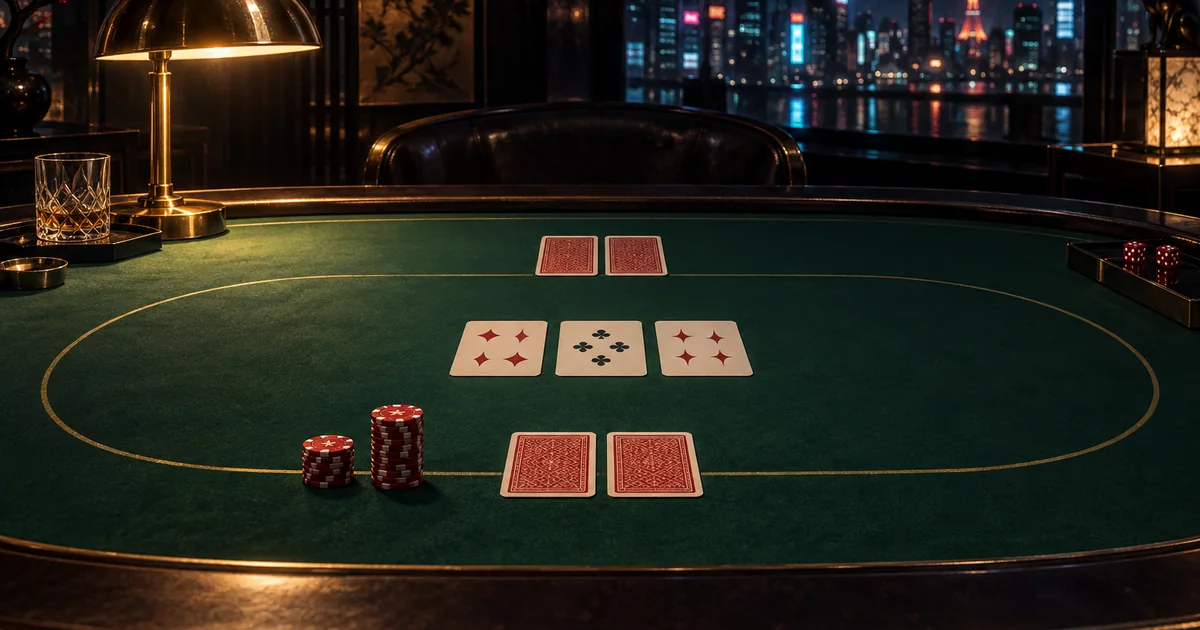
Casino Hold’em is Texas Hold’em with the other players removed and the dealer made mechanical. You post an ante and receive two cards; the dealer receives two, face down; three community cards are dealt. Now the only decision in the game: call, by placing a second bet of exactly twice the ante, or fold and lose the ante. If you call, the turn and river are dealt, the dealer’s cards are turned, and the best five of seven cards on each side are compared.
The dealer does not decide anything. There is no raise to fear and no fold to induce, which is why the game is priced like blackjack rather than like poker: a set of rules, a fixed decision, and a house edge that follows from them. The two rules that carry the edge are the ones a poker player would never have met.
Rule one: the dealer must qualify
If the dealer’s best hand is worse than a pair of fours, the dealer has not qualified, and the showdown does not happen. Your ante is paid according to the bonus table below, which for most hands means ×2, and your call is handed back untouched. You do not need to beat the dealer; you do not even need to have a hand.
This looks like a gift and is a price. The call is the larger bet, twice the ante, and on a non-qualifying dealer it earns nothing. A player who called with a strong hand against a dealer holding rags is paid only on the ante, at ×2, and gets the call back at ×1. The rule converts the dealer’s worst hands, the ones a poker player would win most from, into a small fixed return. It is the Casino Hold’em equivalent of the blackjack rule that a dealer bust pays even money whatever your total.
Rule two: the ante bonus
The second rule is where the game gives some of the edge back, and it is the reason a strong hand is worth calling with even when the dealer might not qualify. When you win a qualified showdown, or when the dealer fails to qualify, the ante is not paid at even money. It is paid by a table keyed to the strength of your own hand.
| YOUR HAND | ANTE PAYS | CALL PAYS (QUALIFIED WIN) |
|---|---|---|
| Royal flush | ×101 | ×2 |
| Straight flush | ×21 | ×2 |
| Four of a kind | ×11 | ×2 |
| Full house | ×4 | ×2 |
| Flush | ×3 | ×2 |
| Straight or less | ×2 | ×2 |
Total-return multiples: ×2 means the stake back plus an equal win. On a non-qualifying dealer the ante column applies and the call is returned at ×1. On a tie both bets push.
Read the two columns together and the structure of the game appears. The call, the big bet, is capped at even money no matter what you hold; the ante, the small bet, carries all the upside. A royal flush pays ×101 on a bet that is a third of your total exposure and ×2 on the other two thirds. That is the opposite of poker, where the pot grows with the strength of the action, and it is deliberate: the bonus makes the big hands memorable while keeping the money that is actually at risk, the call, on a flat price.
The decision and the price
There is one decision and it is closer to blackjack basic strategy than to poker judgement. Folding costs the ante with certainty. Calling risks twice the ante for a hand that wins the showdown some of the time, is paid the bonus on the ante when the dealer misses, and pushes on a tie. The standard analysis of the game, which the engine’s header echoes, is that calling is correct with the large majority of hands after the flop and folding is correct only with the weakest, and that a player who calls sensibly faces a house edge of about 2.2% of the ante.
- Measured on the ante, the edge is about 2.2%. Measured on the total money a calling player puts in motion, ante plus call, it is smaller, because the call is the larger bet and is priced flat.
- Folding too much is the expensive mistake. A fold is a certain loss of the ante; most hands that look weak after the flop still win often enough, or catch a non-qualifying dealer often enough, to be worth twice the ante.
- The bonus is not a reason to chase. It is paid on the ante only, and the hands that earn the big multiples arrive at the rate the deck deals them, which the seed decides before you see the flop.
That last point is the one the engine makes literal. The nine cards of a hand are nine cursors of one nonce, in a fixed order, and the turn and river exist whether or not you call for them; the cursor article walks through the layout. After the seed is revealed, a folded hand can be replayed to the river you never paid to see. Whether that is comforting or not depends on the player, but it is checkable, which is more than a card room offers.
The call is capped at even money and the ante carries the bonus: the big bet is priced flat, and the small one is where the stories come from.the game, in one sentence
How does Casino Hold’em work?
You post an ante and get two cards; the dealer gets two; a three-card flop is dealt. You call for twice the ante or fold. If you call, the turn and river are dealt and the best five of seven cards on each side are compared.
What does it mean for the dealer to qualify?
The dealer needs a pair of fours or better. If the dealer does not qualify there is no showdown: your ante is paid by the bonus table and your call is returned.
What is the ante bonus?
On a qualified win, or when the dealer fails to qualify, the ante pays by hand strength: ×101 royal flush, ×21 straight flush, ×11 four of a kind, ×4 full house, ×3 flush, ×2 straight or less, total return. The call pays 1:1 on a qualified win.
What is the house edge?
The engine header states about 2.2% of the ante with sound calling. Folding too often raises it, because a fold is a certain loss of the ante.
Can a folded hand be verified?
Yes. All nine cards come from one seed pair and nonce in a fixed order; the turn and river are only read if you call, but they can be recomputed after the seed is revealed.
- Betkyo engine source: holdem/derive.ts (deal order, heDealerQualifies, heAnteBonusX, heEvaluate7, the header’s rules and edge), _shared/demoLocal.ts (holdem settlement)
- Wikipedia — Casino Hold’em: rules and the standard analysis of calling strategy