

The zone
Schüll’s book opens with a woman named Mollie, a Las Vegas local who played video poker most days and who explained, when asked why, that she was not playing to win. “I’m not playing to win,” Schüll quotes her; she played to stay in the zone, the state in which nothing else existed, the machine and she and the rhythm of the buttons. Winning was a problem, because a win interrupted it.
That inversion, in which the money is the price of the state rather than the point of the game, is the book’s central observation, and it explains something the standard picture of gambling cannot: why the most devoted machine players will describe a big jackpot as an irritation. The zone is a flow state, the same absorption a musician or a surgeon reports, arriving through an activity that asks nothing of the player except the next press. Schüll’s argument is that the industry understood this before the psychologists did, and built for it.
The zone is not something the player brings to the machine. It is something the machine is built to produce.the thesis of Addiction by Design, compressed
The levers
The book is unusual for a work of anthropology in that its evidence is largely from the other side of the counter: designers, engineers, floor managers, trade shows. The levers they described are specific.
| LEVER | WHAT IT DOES | WHAT IT REMOVES |
|---|---|---|
| Speed | A spin every few seconds, results before the last animation has ended | The pause in which a decision to stop could form |
| Continuous play | Credits instead of coins; ticket-in, ticket-out; autoplay | The physical interruption of feeding a machine or collecting |
| Losses disguised as wins | A multi-line spin that returns less than the stake, celebrated with the sound and light of a win | The felt experience of losing on most spins |
| Near misses | Reels that stop one symbol short of a line | The sense that a loss was a loss |
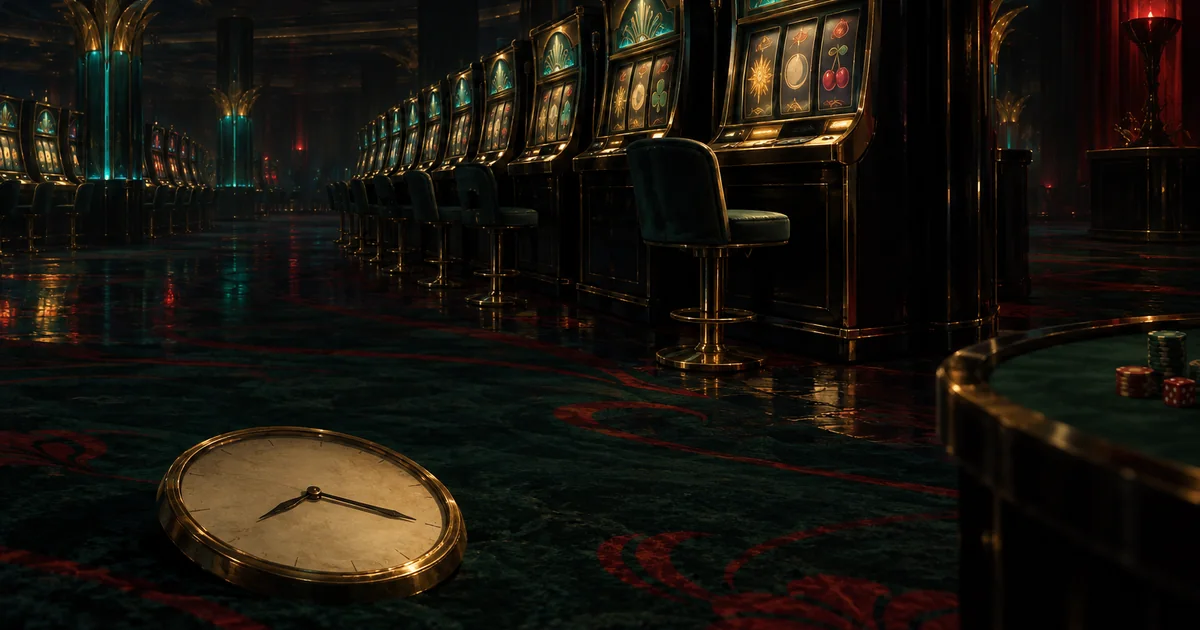
| The floor | No clocks, no windows, curved aisles, seats built for hours | External cues that time is passing |
Every row is a choice a designer makes and can unmake. The industry metric they serve is time on device.
The lever that has been studied most carefully since is the third. In a multi-line slot a player stakes across many lines at once and often “wins” on one or two of them for less than the total stake; the machine presents that spin with a win animation. Mike Dixon and colleagues at the University of Waterloo showed in 2010 that these losses disguised as wins produce the same skin-conductance response as real wins, and later that players who experience them overestimate their number of winning spins. The player has lost money and their body has been told they won. Repeated a few hundred times an hour, that is a powerful reason not to notice the clock.
What exists here
It is fair to ask which of those levers this site has, because a site can write about the zone and still build for it. The honest answer is that some are absent by the nature of the medium and some are choices.
- The floor is your room. There are no windowless halls here; the clock on your device is always a glance away, and nothing on the page hides it.
- Speed is real. Dice, Limbo and the other originals settle in a fraction of a second, and a fast game is a fast game whether it is in a cabinet or a browser. The pause between rounds is yours to insert, which is what a stake set in advance is for.
- Every result is one number you can read. The multiplier on each round is shown as a figure, and a round that returns less than the stake shows a multiplier below one. There is no separate “win” state to dress a loss in.
- Streaks carry nothing. Each round is a hash of the committed seed pair and the round number, so the zone’s sense that the next press is connected to the last is, on this engine, provably false; the hot hand article walks through why.
That is a description, not a clean bill. A game that shows a ×0.5 multiplier honestly is still a game that can be pressed three hundred times an hour, and Schüll’s point about speed does not depend on the honesty of the display. The lever that matters most is the one only the player can pull: deciding, before the first round, when the session ends.
Pulling the other lever
- Set the end before the start. A session limit or a loss limit chosen with a clear head is a decision the zone cannot make for you. The toolkit lists what the settings page offers.
- Keep a clock in view, and treat the surprise of how much time has passed as information rather than embarrassment. It is the zone doing what it is built to do.
- Read the multiplier, not the animation. Below one is a loss. If a round felt like a win and the number says otherwise, believe the number.
- Stop on a schedule, not on a feeling. The feeling that one more round will restore something is the break-even effect, and it does not know what time it is.
What is the machine zone?
The absorbed, time-blind state that continuous machine play produces. Natasha Dow Schüll documented it in Addiction by Design (2012) and argued that it is manufactured by machine and floor design rather than brought by the player.
What are losses disguised as wins?
Spins on multi-line slots that return less than the total stake but are presented with the sound and light of a win. Research by Dixon and colleagues shows they produce the physiological response of a win and lead players to overestimate how often they won.
What is time on device?
The industry’s measure of how long a player stays at a machine. Speed, continuous play, disguised losses, near misses and floor design are levers that extend it.
Does this site use those levers?
The floor levers do not exist in a browser, and results are shown as a plain multiplier with no separate win display, so a round below stake reads as a loss. Speed is real, and the pause between rounds has to be the player’s own.
What is the practical defence?
Decide the end of the session before it starts, using the settings page limits; keep a clock in view; read the multiplier rather than the animation; and stop on a schedule rather than on a feeling.
- Schüll, N. D. (2012). Addiction by Design: Machine Gambling in Las Vegas. Princeton University Press
- Dixon, M. J., Harrigan, K. A., Sandhu, R., Collins, K., & Fugelsang, J. A. (2010). “Losses disguised as wins in modern multi-line video slot machines.” Addiction, 105(10), 1819–1824
- Betkyo engine source: _shared/demoLocal.ts (settlement and result objects), _shared/rng.ts (round derivation)