
Fifteen seconds
A roulette ball is a physical object. Once the croupier has sent it round the track, its speed, the speed of the rotor and the friction slowing both are, in principle, enough to say roughly where it will drop. Norman Packard, a physics graduate student at the University of California, Santa Cruz, started from exactly that idea in the mid-1970s, and his childhood friend J. Doyne Farmer, another physics student there, took it up with him. The opening they found was time: Farmer says that about 15 seconds pass between the release of the ball and the close of betting, and that bets close only a few seconds before the ball leaves the track.
They called themselves Eudaemonic Enterprises. Bass, who joined as a bettor and later wrote the book, describes a six-year project run by physicists and friends who shared a house in Santa Cruz, with winnings to go into a shared “pie” divided by what each member put in. Farmer says the dream was a science commune funded by the casino and independent of the military. Over the years about 20 to 30 people took part at different times, most in small roles; four or five built the computers and did the physics.
They were not the first. Edward Thorp had conceived roulette prediction in 1955 and built a device with Claude Shannon at MIT between November 1960 and June 1961: a cigarette-pack-sized analog circuit of 12 transistors, with toe switches as the input and a tiny speaker in the ear playing one of eight tones, one for each octant of the wheel. They tested it in Las Vegas in the summer of 1961 with ten-cent chips, but the hair-thin wires to the earpiece kept breaking. Thorp recalls that around 1969 a member of the future Eudaemonic group phoned him, and that he went through his and Shannon’s work and results in detail.
The rig
The first version was worn on the body. Farmer describes a computer under one armpit, a pack of 12 AA batteries under the other, a plate of solenoids, a wiring harness running up from the shoes and an antenna wrapped round the shoulder. Most of the bettors, he says, were women, with the signalling device sewn into a bra. Bass lists battery belts and underwear wired with antennas among the prototypes.
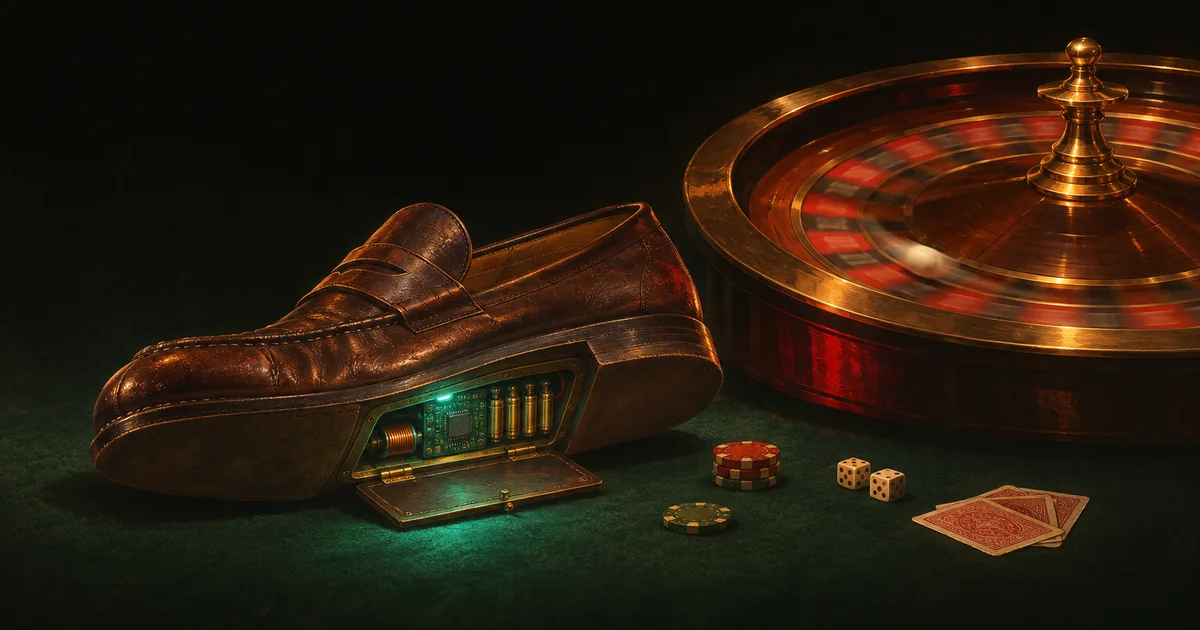
The final version went into the shoes. Bass describes a computer built on the CMOS version of the 6502 microprocessor, the chip family of the early Apple, with microswitches under the toes for input, solenoids under the sole for output, batteries in the heel and just enough antenna wire for a radio link from one shoe to the other. The method was the same throughout. One person at the table tapped a toe switch each time the ball passed a reference point, and again for the rotor; the computer solved the motion of a ball rolling round a circular track; and it sent the bettor one of nine signals, eight naming an octant of the wheel and a ninth meaning “no bet”. The bettor felt the signal through the feet and had to know by heart which numbers sat in each octant.
Farmer says they bet on three numbers in the part of the wheel the computer pointed to, and that the prediction was good enough to say the ball was very unlikely to land on about eight numbers on the opposite side. In one session described by The Conversation, the first prediction was the octant holding 1, 13, 24 and 36, and the ball landed on 13, paid at 35 to 1. Those four numbers sit side by side on an American double-zero wheel, between 3 and 00; on a single-zero European wheel they are spread over 12 pockets, which fits a Nevada table.
The hardware was the real opponent. Accounts of the book describe short circuits from sweat, loose wires, lost radio contact, and switches and actuators that shocked or burned the people wearing them, followed by hurried repairs in the bathroom. The second generation was set in resin blocks with only the toe switches and solenoids exposed, to keep out sweat and stop wires working loose.
44% or 20%: two pockets of blur
Two numbers attach to the system, and they are not the same kind of number. Bass wrote that the shoe gave the group up to a 44 percent advantage, as much as $1.44 back for every dollar on the table. Thorp, citing the book, calls 44% the expectation they reported. Farmer, who built it, says they played at about a 20% edge over the house. The first is a best case; the second is what happened at the tables.
An edge of that size is less visible than it sounds. On a 38-pocket wheel a straight-up win returns 36 units including the stake, so a bet on k numbers with edge E needs a hit rate of k × (1 + E) ÷ 36, against k ÷ 38 by chance.
| BET | BY CHANCE | NEEDED | EXTRA HIT |
|---|---|---|---|
| 3 numbers, +20% | 7.89 % | 10.00 % | 1 in 47.5 spins |
| 3 numbers, +44% | 7.89 % | 12.00 % | 1 in 24.4 spins |
| 4-number octant, +44% | 10.53 % | 16.00 % | 1 in 18.3 spins |
| 1 number, +44% | 2.63 % | 4.00 % | 1 in 73.1 spins |
Calculation for this article. Any +20% bet needs 1.267 times the chance hit rate; any +44% bet needs 1.52 times it. Farmer’s case is the first row: about two extra hits per hundred spins.
Why the gap? Thorp’s paper gives the key. Assuming the total prediction error was roughly normal, he and Shannon needed a spread of about 16 pockets or less to have any edge at all, and at about 10 pockets they had about 44% on the best single number and about 43% on the best octant. A simple model with a normal error wrapped round a 38-pocket wheel reproduces those figures: break-even at 16.2 pockets, +43.8% on one number and +42.4% on a five-number octant at 10. Run it backwards and Farmer’s +20% on three numbers implies a spread of about 12.1 pockets, while +44% on three numbers implies about 10.0.
| SPREAD | RETURN |
|---|---|
| 6 pockets | +137 % |
| 8 pockets | +79 % |
| 10 pockets | +43 % |
| 12 pockets | +21 % |
| 14 pockets | +8 % |
| 16 pockets | +0.4 % |
| 18 pockets | −3 % |
Calculation for this article: normal error with the given standard deviation in pockets, wrapped round a 38-pocket wheel, three adjacent numbers centred on the prediction. Real error is not exactly normal (frets and deflectors scatter the ball), so this illustrates the shape, not the Eudaemons’ measured error.
So the difference between the book’s figure and the builder’s is about two pockets of extra blur, roughly a twentieth of a revolution of the wheel. A slightly late toe tap, a tilted wheel, a deflector that kicks the ball further than usual: each adds a little spread, and the edge falls fast. The same model at 12.1 pockets also matches Farmer’s other remark: the eight pockets opposite the prediction catch about 15.8% of balls against 21.1% by chance, a quarter fewer.
Broken computer or bad luck?
A +20% edge on three numbers means a 10% hit rate per spin where chance gives 7.89%. That is a real advantage and a noisy one. With one unit on each of the three numbers, the chance of being ahead after a given number of predicted spins works out as follows.
| SPINS | AT +20% | NO EDGE |
|---|---|---|
| 100 | 67.9 % | 39.2 % |
| 300 | 80.5 % | 33.9 % |
| 500 | 90.0 % | 36.1 % |
| 1,000 | 96.2 % | 29.3 % |
Calculation for this article. “No edge” is an ordinary 3-number bet on a 38-pocket wheel (−5.26%). At +20% the chance of being ahead stays above 95% only from about 900 predicted spins.
Over an evening of a few hundred spins, a working system loses about one session in five, and an ordinary bettor wins about one in three. From the chips alone, a team cannot tell a failing computer from a bad night. That is the situation the Eudaemons were in every time something went wrong, and it is why Farmer gives hardware errors and the fear of casino security as the reasons they never pushed the stakes: every time they raised them, he says, things got tense.
The end came in November 1981, in a downtown Las Vegas casino, with Farmer timing and Bass betting. The Heinz Nixdorf MuseumsForum, which now displays the shoe as the first computer you could walk on, says that after a winning bet on 13 the solenoids in Bass’s shoe began to twitch at random: electronics in the casino were swamping the radio link, a fix would have taken months, and the team gave up, consoling itself with the roughly $10,000 it had won. At +20%, $10,000 implies about $50,000 wagered across the whole project (calculation for this article; the stakes themselves are not in the record).
Farmer finished his PhD in 1981, and he and Packard went on to chaos research and then to Prediction Company in Santa Fe, which applied the same habit of mind to financial markets. That, Farmer says, is where they finally made their money. In 2012 two researchers, Michael Small and Chi Kong Tse, published a study in the journal Chaos showing that counting ball and rotor revolutions on a casino-grade wheel could give an expected return of at least 18%, against −2.7% for a random bet.
The 1985 law
In 1985 Bass published The Eudaemonic Pie. On 30 May 1985 Nevada approved Senate Bill 467, “prohibiting the use of a device for calculating probabilities”. It made it unlawful at a licensed gaming establishment to use, or possess with intent to use, any device to assist in projecting the outcome of a game, keeping track of the cards, analysing the probability of an event in the game, or analysing the strategy for playing or betting. A first offence carried 1 to 10 years in prison, a fine of up to $10,000, or both.
The timing is tempting, but the record does not tie the law to the book. The Associated Press reported the bill as aimed at hidden card-counting computers for blackjack, sold for up to $3,000 in Southern California and elsewhere, and Thorp writes that it was signed as an emergency measure aimed at blackjack and roulette devices. The section is now NRS 465.075, broadened to any device, software or hardware designed to obtain an advantage at a game; since July 2020 a first offence has been a category C felony, punishable by 1 to 5 years and a fine of up to $10,000. The Eudaemons played from 1976 to 1981, before the section existed, and no source reports a charge against any of them.
No ball in flight
The whole Eudaemonic project lived inside those 15 seconds: a physical ball, in motion, while bets were still open. The Ritz laser scanner case shows the same window used with a phone in 2004, and why measuring a wheel was not, in itself, a crime in England. An online wheel has no such window, because it has no ball.
On this site the pocket is a function of the round’s committed server seed, your client seed and the round number. Nothing is in motion before the bet, so there is nothing to time and no spread to shrink; every straight-up number keeps its 1-in-37 chance and every bet returns 97.30% over the long run. A wheel with a real bias, or a ball you can time, is a different game, and wheel bias is the other way players have found an edge on physical tables. And if an edge ever does exist, sizing the bets matters as much as finding it: Thorp chose octants over single numbers for exactly that reason, as the Kelly criterion explains.
A wheel with nothing in flightSingle zero, 37 pockets, every bet returns 97.30% — the pocket is floor(u × 37) from the round’s hash, under the published ruleRoulette →
Who were the Eudaemons?
A group of physics students and friends in Santa Cruz, California, led by J. Doyne Farmer and Norman Packard, who from 1976 to 1981 tried to predict roulette with physics and a computer hidden in a shoe. Thomas Bass, one of their bettors, told the story in The Eudaemonic Pie (1985).
How did the Eudaemons’ shoe computer work?
One player tapped a toe switch to time the ball and the rotor during the roughly 15 seconds before betting closed. A small 6502-based computer in a shoe predicted the likely octant of the wheel and sent one of nine signals by radio to a bettor, who felt it through solenoids and bet on numbers in that part of the wheel.
Did the Eudaemons really have a 44% edge?
No. Bass wrote that the system gave up to a 44% advantage, a best case. Farmer, who built it, says they played at about a 20% edge over the house, did not get rich, and the museum that holds the shoe puts their winnings at about $10,000.
Why was the real edge so much lower than 44%?
Prediction error. In a simple model that reproduces Thorp’s published figures, about +44% on three numbers needs a prediction spread of about 10 pockets and +20% about 12, so two extra pockets of blur cut the edge by more than half (calculation for this article).
Is using a roulette computer illegal?
In Nevada, yes. Senate Bill 467, approved on 30 May 1985 and now NRS 465.075, makes it a felony to use or possess a device to predict outcomes or gain an advantage at a game in a licensed casino. The Eudaemons played before the law and were never charged.
Can an online roulette wheel be predicted the same way?
Not on this site. There is no ball and no rotor; the pocket is floor(u × 37), where u comes from a hash of the committed server seed, your client seed and the round number, so there is nothing in motion to time.
- Thomas A. Bass, “Dress Code”, Wired, April 1998 — the shoe computer (CMOS 6502, toe switches, solenoids, heel batteries, shoe-to-shoe radio), the early body-worn prototypes, “up to a 44 percent advantage”, the six-year project and the shared pie
- J. Doyne Farmer, interview, Hear This Idea, 13 June 2022 — about 15 seconds before bets close, the armpit rig, three numbers and the eight unlikely numbers opposite, about a 20% edge over the house, 11 trips to Nevada, not getting rich, the science commune, Prediction Company
- Heinz Nixdorf MuseumsForum, “Shoe computer” — the first computer you could walk on, the November 1981 session with Farmer timing and Bass betting, random solenoids after a win on 13, the radio link disrupted by casino electronics, about $10,000 won
- Edward O. Thorp, “The Invention of the First Wearable Computer”, Proceedings of ISWC 1998 — the Thorp–Shannon device of 1960–61, the 16-pocket break-even, about 44% / 43% at about 10 pockets, the 1969 call from the future Eudaemonic group, the 30 May 1985 law aimed at blackjack and roulette devices
- Graham Kendall, “How Isaac Newton could help you beat the casino at roulette”, The Conversation, 2016 — the resin-set second generation, the 1-13-24-36 octant and the hit on 13, the final session at Binion’s
- UC Irvine Libraries, Edward O. Thorp exhibit, item 040 — Nevada Senate Bill 467 as approved on 30 May 1985 (section 1 and the penalty in section 2) and the AP Carson City report on the bill
- NRS 465.075, 465.088 and 193.130 (nevada.public.law and PocketLaw mirrors) — the current device section, its history note, and the category C penalty for a first offence since 1 July 2020
- M. Small and C. K. Tse, “Predicting the outcome of roulette”, Chaos 22, 033150 (2012), arXiv:1204.6412 — an expected return of at least 18% against −2.7% for a random bet
- Betkyo engine source: roulette/derive.ts and RouletteEngine.derivePocket() (the pocket is floor(u × 37) from the committed server seed and the client seed)
- Calculation for this article: hit rates needed for a given edge, the wrapped-normal error model, the eight-opposite-pockets share, exact binomial chances of being ahead, the implied amount wagered