
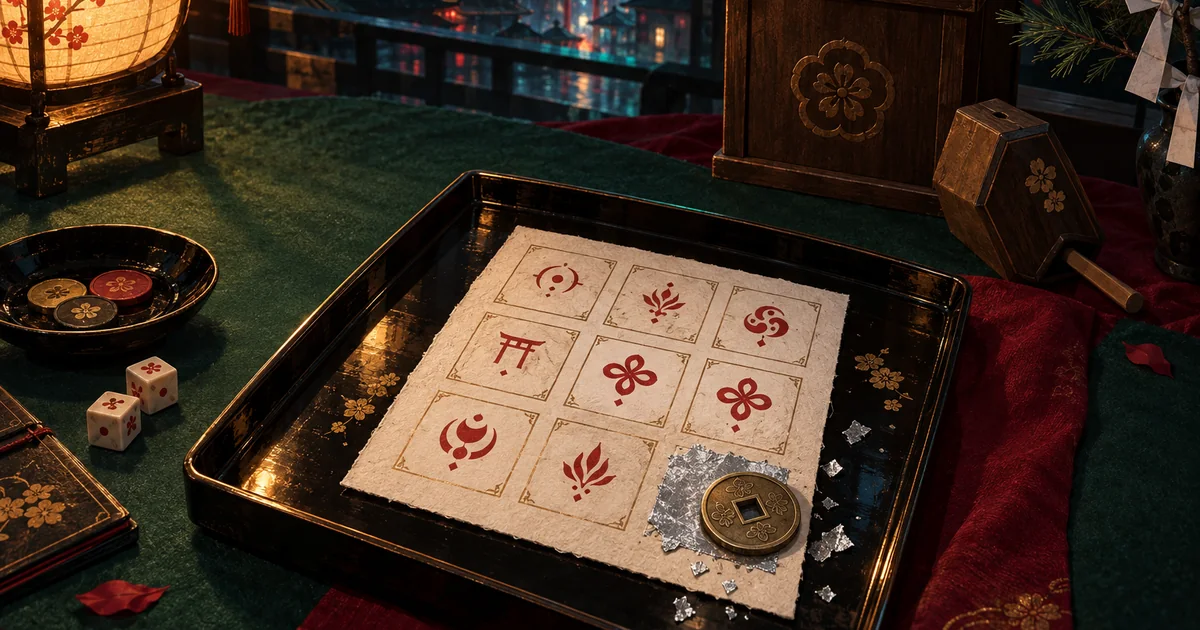
One roll decides the card
An omikuji card looks like a scratch game — nine cells, scratch them, hope for three of a kind — but the engine decides the whole card with one number before any cell exists. The first draw from the round’s seed stream is an integer from 0 to 999,999. The six fortune tiers own consecutive ranges of that million, in the order below; if the roll lands in a tier’s range the card wins that tier, and if it lands in the remaining 691,000 the card pays nothing. Only then are the glyphs painted on.
| TIER | PAYS | CHANCE PER CARD | ONE CARD IN | ADDS TO RETURN |
|---|---|---|---|---|
| 大吉 Daikichi | ×100 | 0.100% | 1,000 | 10.00 points |
| 中吉 Chūkichi | ×20 | 0.600% | 167 | 12.00 points |
| 小吉 Shōkichi | ×8 | 2.000% | 50 | 16.00 points |
| 吉 Kichi | ×4 | 4.500% | 22 | 18.00 points |
| 半吉 Hankichi | ×2 | 10.000% | 10 | 20.00 points |
| 末吉 Suekichi | ×1.5 | 13.700% | 7.3 | 20.55 points |
| Any win | — | 30.900% | 3.2 | 96.55 points |
| No match | 0 | 69.100% | 1.4 | — |
Multipliers are total return per unit staked (×1.5 returns $15 on $10, a $5 profit). “Points” are percentage points of stake.
Read the right-hand column and the card inverts: the fortune everybody scratches for is the smallest contributor to the return, and the fortune nobody wants — 末吉, “blessing to come”, a 50-cent profit on a dollar — is the largest. That is not a quirk; it is how a 30.9% hit rate and a ×100 top prize fit inside the same 96.55%. Two thirds of the return is paid in ×1.5, ×2 and ×4 wins, which is where almost every session’s money actually comes back from.
What the edge costs
A 3.45% edge is a mid-priced card on this site — about a third more than Chinchiro or roulette, a little under the slots. Per 100 cards at $10 the expected cost is $34.50, which slots between Bingo ($33.40) and Tairyō (about $37) on the per-hundred table. Pace is yours: a card every ten seconds is 360 cards an hour, about $124 at $10 and $12.40 at $1.
| QUANTITY | VALUE |
|---|---|
| Expected number of winning cards | 30.9 |
| Expected cost | $34.50 |
| Standard deviation of the result | about $377 |
| Chance of at least one 大吉 (×100) | 9.5% |
| Chance of at least one 中吉 or better | 50.4% |
| Chance of a run of 10 losing cards somewhere in the hundred | very likely — a single run of 10 losses is 2.5%, and a hundred cards contain many starting points |
Standard deviation per $1 card is 3.77 (second moment 15.1); over 100 cards ×√100 ×$10. The 大吉 chance is 1 − 0.999¹⁰⁰; the 中吉-or-better chance is 1 − 0.993¹⁰⁰.
The standard deviation is eleven times the expected loss, which is the shape of every top-heavy paytable: the session result is mostly noise, and the edge is what remains when the noise averages out. A 大吉 needs, on average, a thousand cards; half of all players who keep going will have seen one by card 693, and a quarter will still be waiting at card 1,386. At $10 a card those are $6,930 and $13,860 of turnover for a $1,000 prize — which is the ×100 stated in dollars rather than in multipliers.
The two-大吉 card
Here is the part the scratch format exists for. A card has nine cells and seven kinds of glyph — the six fortunes plus 凶 — and the paint rule caps every non-winning glyph at two copies. Nine cells across seven kinds with a cap of two means at least two kinds must appear twice. So a losing card is never a spread of singles: it always carries at least two pairs, and usually three.
| PAIRS OF FORTUNE GLYPHS ON THE CARD | SHARE OF LOSING CARDS |
|---|---|
| 1 pair (the other pair is 凶凶) | 3.1% |
| 2 pairs | 31.8% |
| 3 pairs | 50.9% |
| 4 pairs | 14.1% |
| Two 大吉 glyphs on the card | 46.0% |
| Two 大吉 or two 中吉 | 74.1% |
From 2,000,000 cards through the engine’s paint rule; the pair minimum of two is exact by counting (9 cells, 7 kinds, cap 2).
Put the two tables together. A card that pays ×100 is one in a thousand. A card that shows two 大吉 and pays nothing is 46% of 69.1%, which is 31.8% of all cards — 318 of them for every real 大吉. The “so close” card is not close to anything: the roll that decides the card was made before the glyphs were, and the two 大吉 are filler chosen from whatever was still allowed. The same is true inside a win — about a quarter of winning cards also show a pair of a higher tier than the one they paid, 末吉 with two 大吉 looking on.
This is the honest version of a design every scratch card and most slots use, and the near-miss piece covers why it works on people: two-of-three reads as progress even when the third was never in play. The difference here is that the rule is printed. Three of a kind pays; two of a kind is the normal appearance of a card that paid nothing, and it would look the same if the top tier were a million to one.
The shrine and the card
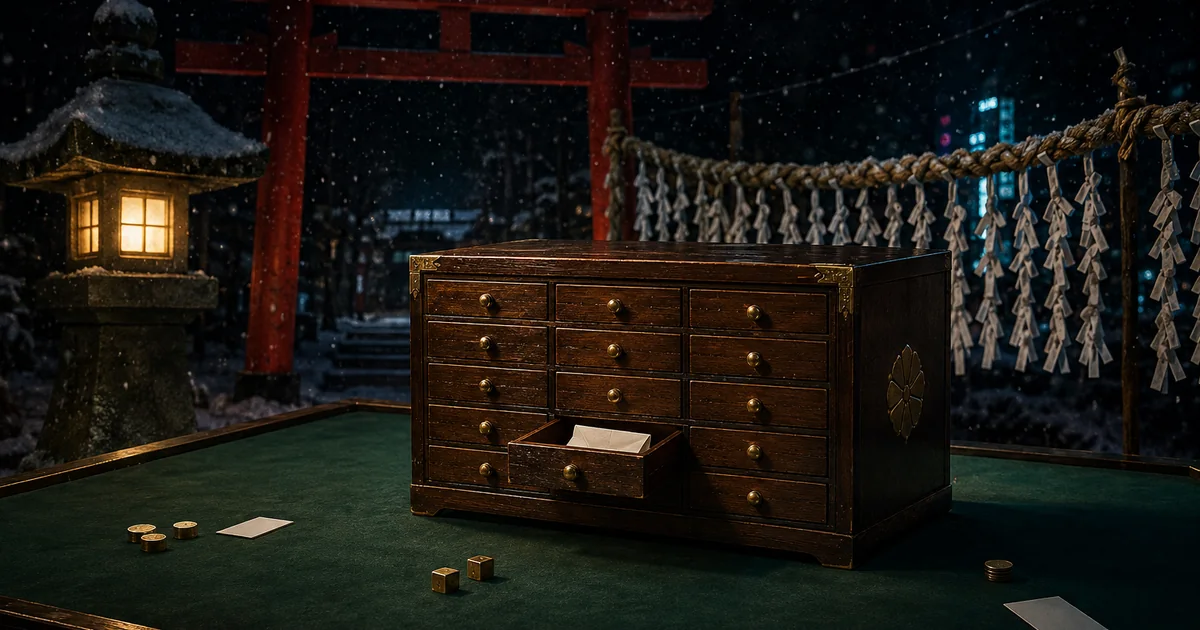
At a shrine the box is private theology: nobody publishes how many 大吉 slips are in it, and the custom of tying a bad fortune to the pine exists because the ratio is not yours to know. The history piece tells that story. The card does the opposite — the ratios are six integers in a source file — and the only mystery left is the one every weighted draw has, which is which range the next roll lands in.
Scratch a card, then recompute itFree play with fun money; the fairness panel shows the tier roll and the paint draws for any card you turn.Omikuji →
What are the odds of 大吉 on Betkyo’s omikuji?
Exactly 1 in 1,000 per card (weight 1,000 in a million). It pays ×100, so it contributes 10 percentage points of the 96.55% return.
How often does an omikuji card win anything?
30.9% of cards: 末吉 13.7%, 半吉 10%, 吉 4.5%, 小吉 2%, 中吉 0.6%, 大吉 0.1%. The other 69.1% pay nothing.
What is the house edge on omikuji?
3.45% — the return is 96.55%. Per 100 cards at $10 that is an expected $34.50, with a standard deviation around $377.
A card showed two 大吉 — was I close?
No. The tier is decided by one roll before the glyphs are painted; the two 大吉 are filler. About 46% of losing cards show two 大吉, which makes that card 318 times more common than an actual 大吉 win.
Can a losing card show three 凶?
No. Every glyph, including 凶, is capped at two copies on a card that is not paying that tier, and 凶 never pays, so three 凶 cannot appear.
Which tier pays out the most money overall?
末吉 (×1.5): 13.7% of cards × 1.5 = 20.55 points of return, more than 半吉 (20), 吉 (18), 小吉 (16), 中吉 (12) or 大吉 (10).
- Betkyo engine source: OmikujiEngine.kt — TIERS (weights in millionths, mult100), derive(): tier roll = first draw below 1,000,000 scanned against cumulative weights; paint rule with per-glyph cap of two; 凶 filler only
- Frontend derivation: omikuji/derive.ts — OMIKUJI_TIERS with glyphs 大吉 中吉 小吉 吉 半吉 末吉 and KYO_GLYPH 凶; the browser verifier recomputes the same stream
- Pair frequencies: 2,000,000 cards drawn through the engine’s paint rule with uniform draws; pair minimum of two per losing card by the pigeonhole count (9 cells, 7 glyph kinds, cap 2)