

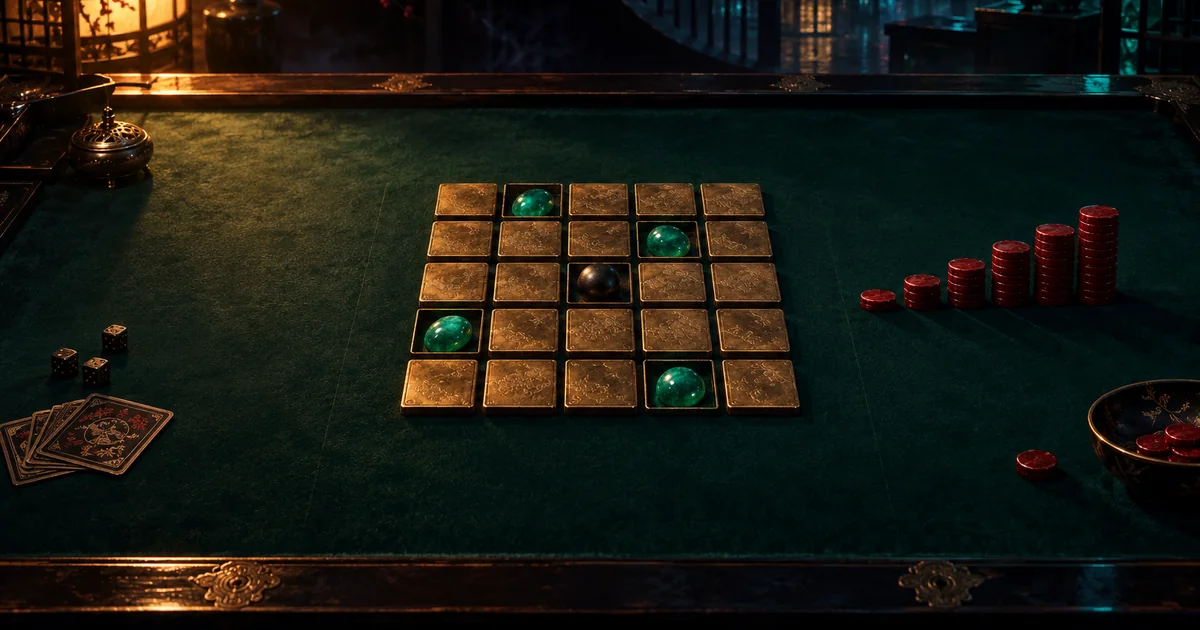
How the mines are placed
Mines is a five-by-five board. You choose how many mines are hidden, from one to twenty-four, and open tiles one at a time. Every safe tile raises the multiplier; a mine ends the round at zero; you can cash out after any safe tile. The game invites strategy — corners, edges, the tile that “feels” safe — and there is none, because of how the mines are laid.
A partial Fisher–Yates shuffle makes every set of m tiles equally likely, and the mines are fixed before your first click. So whatever tile you open, it is a mine with probability m ÷ (tiles still closed). Corners are not safer; a tile next to one you just opened is not more dangerous; the board has no memory of what it showed you. The only number the game reads is how many safe tiles you have opened so far.
The multiplier is the fair odds, floored twice
The chance of surviving k picks with m mines is the number of ways to choose k tiles from the 25 − m safe ones over the number of ways to choose k from all 25: C(25 − m, k) ÷ C(25, k). The engine’s product ∏(25 − i) ÷ ∏(25 − m − i) is exactly the reciprocal — the fair multiplier — and then it does two things to it. It floors the fair number to two decimals, multiplies by 0.99, and floors again.
The 0.99 is the 1% house edge. The floors are what make the table interesting, because a floor to two decimals is worth almost nothing on ×227.70 and a great deal on ×1.04. Here is what one pick pays for each mine count, and what it returns.
| MINES | FAIR MULTIPLIER | PAYS | CHANCE THE TILE IS SAFE | RETURN | EDGE |
|---|---|---|---|---|---|
| 1 | ×1.0417 | ×1.02 | 96% | 97.92% | 2.08% |
| 2 | ×1.0870 | ×1.06 | 92% | 97.52% | 2.48% |
| 3 | ×1.1364 | ×1.11 | 88% | 97.68% | 2.32% |
| 5 | ×1.2500 | ×1.23 | 80% | 98.40% | 1.60% |
| 10 | ×1.6667 | ×1.64 | 60% | 98.40% | 1.60% |
| 15 | ×2.5000 | ×2.47 | 40% | 98.80% | 1.20% |
| 20 | ×5.0000 | ×4.95 | 20% | 99.00% | 1.00% |
| 24 | ×25.0000 | ×24.75 | 4% | 99.00% | 1.00% |
Pays = floor₂(floor₂(fair) × 0.99), as the engine computes it; return = pays × chance. With two mines the fair ×1.0870 becomes ×1.08, then ×1.0692, then ×1.06: the floors take 2.5 cents of a 8.7-cent margin.
So the price of a single pick is not 1%. It is 1% plus whatever the two floors throw away, and on the small multipliers at the bottom of the board that is another point or more. The 1% is only reached where the fair multiplier is large enough that a cent no longer matters — twenty mines on the first pick, or any mine count once you are a few tiles in.
The ladder that does not compound
The surprising part of Mines is what happens as you keep going. In a streak game like RPS every extra win is a new bet of the whole running balance at the same 1.5% edge, so ten wins cost 14%. Mines does not work like that. Each rung is priced from scratch as the fair odds of the whole run minus 1%, so the return at any cash-out point is about 99% — the same whether you stop at the third tile or the twentieth.
| SAFE TILES (k) | PAYS | CHANCE OF GETTING THERE | RETURN IF YOU CASH OUT HERE |
|---|---|---|---|
| 1 | ×1.11 | 88.00% | 97.68% |
| 2 | ×1.27 | 77.00% | 97.79% |
| 3 | ×1.47 | 66.96% | 98.43% |
| 5 | ×1.98 | 49.57% | 98.14% |
| 10 | ×4.99 | 19.78% | 98.72% |
| 15 | ×18.96 | 5.22% | 98.92% |
| 20 | ×227.70 | 0.43% (1 in 230) | 99.00% |
| 22 (the board) | ×2,277.00 | 0.043% (1 in 2,300) | 99.00% |
Chance = C(22, k) ÷ C(25, k). The return climbs toward 99% as the multiplier grows and the floors shrink relative to it; it never goes below the first rung and never above 99%.
Read the other way: the tile-by-tile odds are fair. Going from 10 safe tiles to 11 with three mines is a bet at 12 ÷ 15 = 80% that pays 6.24 ÷ 4.99 = ×1.2505, which is a hair better than fair — the floors happened to fall your way on that rung. The house has already taken its 1% at the bottom of the ladder and does not take it again on the way up. That does not make the deep rungs a good bet in any other sense — a 1-in-230 shot is still a 1-in-230 shot — but it does mean that “cash out early” is not the rule here that it is in RPS. The price of the run is the same wherever you stop, except at the very bottom, where it is worse.
The whole table
There are 300 settings on the board — 24 mine counts, each with as many picks as it has safe tiles — and the engine prices all of them the same way. Of those 300, 171 return 99.0% to one decimal and 66 return exactly 99.00%. Thirty-two return under 98.5%, all of them on multipliers of ×2.17 or less; nothing that pays ×2.20 or more returns under 98.5%. The worst two are one mine at two picks and two mines at one pick, both ×1.06 for a 92% chance: 97.52%.
| MINES | SAFE TILES | PAYS | CHANCE |
|---|---|---|---|
| 1 | 24 | ×24.75 | 1 in 25 |
| 3 | 22 | ×2,277.00 | 1 in 2,300 |
| 5 | 20 | ×52,598.70 | 1 in 53,130 |
| 10 | 15 | ×3,236,072.40 | 1 in 3,268,760 |
Each returns exactly 99.00%. The site’s maximum profit per round applies on top, so the large multipliers pay in full only on a stake small enough to stay under it.
Checking a round
- After the round, rotate your seed pair to reveal the server seed, and confirm its SHA-256 matches the fingerprint you were shown before playing.
- Write the tiles 1…25 in a row. For i = 0 up to one less than the mine count, compute HMAC-SHA256 keyed by the server seed over “clientSeed-nonce-i”, read the first 13 hex digits as a number, divide by 2⁵², multiply by (25 − i) and floor it. The tile at that position is mine i + 1; swap it with the tile at position 25 − i (counting from 1) and continue.
- Check the mine list against the tiles the game revealed, and check the paid multiplier against C(25, k) ÷ C(25 − m, k) floored to two decimals, times 0.99, floored again, for the k safe tiles you opened.
The replay shows the mines were where they were before you clicked. What it cannot show is a tile that was safer than another, because there was none — the whole price of the game is in the two floors and the 0.99, and none of it is in where you click.
What is the house edge in Mines?
1% at the top of the table and up to 2.5% at the bottom. Every multiplier is the fair odds floored to two decimals, times 0.99, floored again; the floors cost almost nothing on large multipliers and a point or more on small ones. The worst setting, one mine at two picks (or two mines at one), returns 97.52%.
Does the house edge grow if I keep picking tiles?
No. Each rung is priced as the fair odds of the whole run minus 1%, so the return is about 99% wherever you cash out — it rises slightly as you go deeper, because the floors matter less on bigger multipliers. This is unlike a streak game such as RPS, where each extra win compounds the edge.
Which tiles are safest in Mines?
None. The mines are placed by a uniform shuffle from the round’s seed pair before your first click, so every closed tile has the same chance of hiding one: mines ÷ tiles still closed. Corners, edges and patterns change nothing.
What are the odds of clearing the board?
C(25 − m, k) ÷ C(25, k) with all safe tiles opened: 1 in 25 with one mine, 1 in 2,300 with three (×2,277), 1 in 53,130 with five (×52,598.70), 1 in 3,268,760 with ten. Each pays exactly 99% of fair, subject to the maximum profit per round.
How many mines should I choose?
The mine count changes the shape of the ride, not its price: more mines mean fewer, bigger steps. Settings whose multipliers are small — few mines and few picks — lose the most to the two-decimal floors; every rung that pays ×2.20 or more returns 98.5% or better.
- Betkyo engine source, house service: OriginalMinesService.kt — start() (mineCount 1–24), createMineListPf() (partial Fisher–Yates: draw i = nextIntBelow(25 − i) at cursor i, swap to the end of the unpicked range), betGameTicket() (multiplier = ∏(25 − i) ÷ ∏(25 − mines − i) floored to 2dp, × (1 − house edge), floored to 2dp; zero on a mine; auto-close on a full clear); client mirror mines/minesApi.ts minesMultiplier()
- Exact calculation written for this article: all 300 (mine count, pick count) settings with the engine’s two floors in exact rational arithmetic; reach probabilities C(25 − m, k) ÷ C(25, k); returns and edges by cash-out point; the distribution of returns across the table (171 of 300 round to 99.0%, 66 exactly 99.00%, 32 under 98.5%, minimum 97.52%)