
Fifteen tiles, three colours
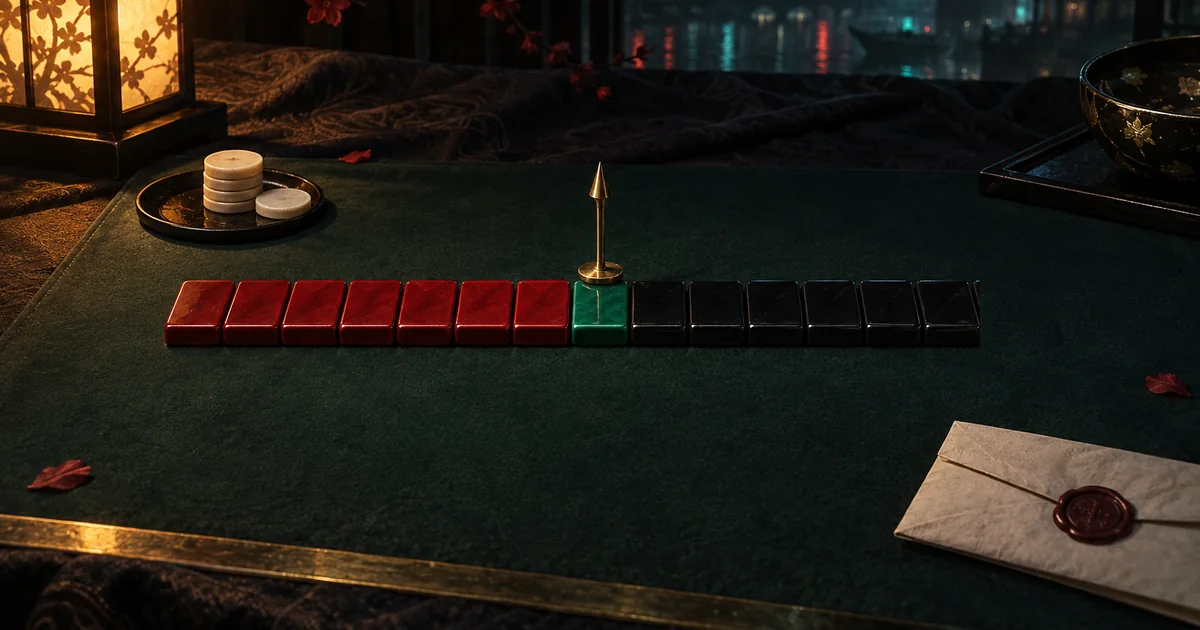
Double is the communal colour game that grew up on skin-gambling sites and Brazilian crash casinos: one strip of tiles scrolls past a pointer, everyone at the table has bet on a colour, and the tile under the pointer pays whoever chose its colour. There is no target to type and no hand to play. The entire game is the count of tiles of each colour and the multiplier each colour pays, and both come straight from the engine.
The multipliers are total return, stake included. A winning red or black bet gets back twice what it staked, a profit of one stake; a winning green gets back fourteen times its stake, a profit of thirteen. That is the convention throughout the Betkyo originals and it is the one the tables below use. The tile strip on screen shows the same figures, 2× on every red and black tile and 14× on the green one.
The price of every colour
With fifteen equally likely tiles, pricing a colour is a division. Red covers seven tiles, so it wins 7 ÷ 15 of the time and is paid twice its stake when it does; the average return is 7 ÷ 15 × 2 = 14 ÷ 15. Green covers one tile, wins 1 ÷ 15 of the time and is paid fourteen times; 1 ÷ 15 × 14 is the same 14 ÷ 15. The wheel is built so that tiles × multiplier equals 14 for every colour, and 14 out of 15 is the whole story of the game’s price.
| COLOUR | TILES | WIN CHANCE | ONE WIN IN | PAYS | RETURN | HOUSE EDGE | SWING PER UNIT STAKED |
|---|---|---|---|---|---|---|---|
| Red | 7 of 15 | 46.67% | 2.14 rounds | ×2 | 93.33% | 6.67% | 1.00 |
| Black | 7 of 15 | 46.67% | 2.14 rounds | ×2 | 93.33% | 6.67% | 1.00 |
| Green | 1 of 15 | 6.67% | 15 rounds | ×14 | 93.33% | 6.67% | 3.49 |
Return = win chance × payout = 14 ÷ 15 on every row. Swing is the standard deviation of one round’s result per unit staked, √(payout² × chance − return²): 0.998 for red or black, 3.49 for green.
The first thing the table says is that there is no smart colour. Green looks like the long shot the house wants you to take, and red looks like the sensible coin flip, but the engine charges both exactly 6.67 cents on the dollar. What differs is the last column: a red bet swings by about one stake per round, a green bet by three and a half. A player who bets green all evening will see long dry spells and occasional fourteen-fold returns; a player on red will see a slow, steady drift. On average they lose at the same rate.
The second thing it says is how that rate compares. Red on Double is the same shape of bet as red on roulette — roughly half the outcomes, paid double — but roulette’s single zero takes 1 tile in 37 and Double’s single green takes 1 in 15. Every roulette bet on this site returns 97.30%, a 2.7% edge; Double’s 6.67% is two and a half times that. Against crash or limbo at 1%, it is more than six times. The green tile is the reason: it is both the jackpot and the house’s whole margin, and the margin is large because the jackpot is.
A fair version of this wheel would pay red ×2.1429 (15 ÷ 7) and green ×15. The engine pays ×2 and ×14. The gap on red is 0.1429 of a stake on each win, 46.67% of the time; the gap on green is one full stake, 6.67% of the time. Both come to 6.67% of the money bet, which is how the same edge can be hidden in a small shortfall paid often and a big one paid rarely.
Betting two colours at once
The engine keeps a separate stake for each colour in a round, so a player can bet red and black together, red and green, or all three. Each colour is settled on its own: whichever tile lands, the stake on that colour is paid its multiplier and the other stakes are lost. That makes every combination easy to price, and every one of them returns the same 93.33%.
| BET | STAKED | WHAT COMES BACK | RETURN | SWING PER UNIT STAKED |
|---|---|---|---|---|
| Red only | 1 | 2 on red (46.67%), 0 otherwise | 93.33% | 1.00 |
| Red + black | 2 | 2 on red or black (93.33%), 0 on green (6.67%) | 93.33% | 0.25 |
| Red + green | 2 | 2 on red (46.67%), 14 on green (6.67%), 0 on black (46.67%) | 93.33% | 1.79 |
| Red + black + green | 3 | 2 on red or black (93.33%), 14 on green (6.67%) | 93.33% | 1.03 |
Return is the average amount back divided by the amount staked. Red + black: (2 × 14 ÷ 15) ÷ 2. Red + green: (2 × 7 ÷ 15 + 14 × 1 ÷ 15) ÷ 2. All three: (2 × 14 ÷ 15 + 14 ÷ 15) ÷ 3. Swing is the standard deviation of the round’s result divided by the total staked.
Red plus black is the combination players reach for when they want to “cover” the wheel, and the table shows what it buys: a round that pays back exactly what was staked fourteen times in fifteen, and loses both stakes on the fifteenth. The swing falls to a quarter of a stake, so a session feels calm, but the price is unchanged — 6.67% of everything staked, paid in one lump whenever green lands. Two units on red and black is not a safe bet; it is two units’ worth of the same bet with the noise averaged out.
Adding green to a colour bet does the opposite, raising the swing while leaving the return alone. There is no combination of the three colours, at any stake ratio, that returns more than 14 ÷ 15, because each colour’s stake is priced at 14 ÷ 15 on its own and a sum of bets returns the weighted average of its parts. The only way to change the price of a Double round is to stake less.
How long green takes
Green lands on one tile in fifteen, so the average gap between greens is fifteen rounds. Averages mislead on a game like this: the wait has no memory, the outcome of each round is fixed by the chain link when the round opens, and a long dry spell makes the next green exactly as likely as it was, 6.67%. The useful figures are the chances of a wait of a given length.
| ROUNDS | AT LEAST ONE GREEN | NO GREEN AT ALL | ABOUT |
|---|---|---|---|
| 5 | 29.18% | 70.82% | 1.6 minutes |
| 10 | 49.84% | 50.16% | 3 minutes |
| 11 | 53.18% | 46.82% | 3.4 minutes |
| 15 | 64.47% | 35.53% | 4.7 minutes |
| 20 | 74.84% | 25.16% | 6.2 minutes |
| 30 | 87.38% | 12.62% | 9.4 minutes |
| 45 | 95.52% | 4.48% | 14 minutes |
| 100 | 99.90% | 0.10% | 31 minutes |
No green in N rounds = (14 ÷ 15)ᴺ. The median wait is 11 rounds: the first round at which the chance of having seen a green passes one half. Minutes assume 18.7 seconds a round.
The median is eleven rounds, not fifteen, because the distribution is lopsided: most waits are short and a few are very long, and the long ones pull the average up. One player in eight sits through thirty rounds without a green; one in a thousand sits through a hundred. In a hundred rounds the number of greens is most often six or seven, is five or fewer about a third of the time, and reaches ten or more about one time in ten. None of that is a pattern to play; it is what a 1-in-15 tile looks like over an hour.
The same arithmetic prices runs of a single colour, which is where the gambler’s fallacy does its work on this game. Red five times in a row happens 2.21% of the time, about once every 45 rounds; eight in a row, 0.22%; ten in a row, 0.05%. A run of eight or more non-red results, the sequence that breaks a martingale on red at the ninth doubling, begins roughly once every two hours at this pace. The martingale, priced works through the doubling on a roulette wheel; on Double the losing chance per round is 8 ÷ 15 instead of 19 ÷ 37, so every streak is likelier and every series shorter.
What an hour costs
Because the rounds are shared, the pace is fixed by the server rather than the player: twelve seconds to bet, a short lock, six seconds to show the result, then the next round opens. That is about 18.7 seconds a round and close to 192 rounds an hour. A flat one-unit bet on any colour, every round, stakes 192 units an hour and gets back 179.2 on average — a cost of about 12.8 units an hour. The same bet on a roulette even chance at the same pace would cost about 5.2; at limbo ×2, about 1.9.
The hourly figure is the honest way to compare the games, because it puts the edge and the pace together. Double is among the more expensive games on the site per round, and it is also fast, always running, and built around a shared timer that nudges everyone to bet every round. Sitting out a round costs nothing; on a 6.67% wheel it is the only bet that is free.
Red and black pay ×2, green ×14 — the odds are 7 in 15 and 1 in 15, and every round’s link is revealed after it landsDouble →
Checking a round yourself
Double does not use a per-player seed pair. Like crash and the wheel, it runs on a hash chain: before the first round the server publishes the commit hash of the chain and a fixed public salt, and after each round it reveals that round’s link. Hashing a revealed link with SHA-256 gives the previous round’s link, all the way back to the commit, which is how the chain proves the order of outcomes was fixed before anyone bet.
- Take the round’s revealed link and the salt from its verify entry — the ×2 and ×14 chips in the history strip open one for each past round.
- Compute HMAC-SHA256 with the link as the key and the salt as the message. Take the first seven bytes of the digest as a 56-bit integer and divide by 2⁵⁶ to get u.
- The slot is floor(u × 15). Slot 0 is green, 1 to 7 red, 8 to 14 black. It should match the tile the round landed on, and SHA-256 of this link should equal the previous round’s link.
One detail for the exact-minded: 2⁵⁶ is not a multiple of 15 — it leaves a remainder of 1 — so the floor gives slot 0 one more of the 2⁵⁶ possible values than the other slots. Green’s true chance is 1 ÷ 15 plus 1.3 × 10⁻¹⁷, an excess that would take on the order of 10¹⁷ rounds to notice. The 6.67% in the tables is right to every decimal that will ever matter. What a hash commitment proves explains what the chain does and does not guarantee; the short version is that it fixes the outcomes in advance, and it is the published 7-7-1 tile count that fixes the price.
What are the odds of green in Double?
1 in 15, or 6.67% a round, because the wheel has one green tile among fifteen. Green pays ×14 (a profit of thirteen stakes). The average wait between greens is 15 rounds and the median is 11; the chance of no green in 30 rounds is 12.6%.
What is the house edge in Double?
6.67% on every colour. Red and black win 7 in 15 and pay ×2 (return 93.33%); green wins 1 in 15 and pays ×14 (return 93.33%). The wheel is built so that tiles × multiplier = 14 for each colour, and 14 ÷ 15 is the return of any bet or combination of bets.
Is betting red and black at the same time a good strategy?
It lowers the swing, not the price. Red plus black returns the pair 14 times in 15 and loses both stakes on green, which is still a 93.33% return — a 6.67% edge on twice the money. No combination of colours returns more than 14 ÷ 15.
Is green in Double a bad bet?
No worse than red or black in expectation: all three return 93.33%. Green is far more volatile — a standard deviation of 3.49 stakes a round against 1.00 for red — so it pays rarely and big rather than often and small. Choose it for the variance, not the value.
How many rounds of Double are there in an hour?
About 192. A round is a 12-second betting window, a 0.7-second lock and a 6-second result phase, roughly 18.7 seconds in all. A flat one-unit bet every round costs about 12.8 units an hour on average at the 6.67% edge.
Can I verify a Double spin?
Yes. Each round reveals its chain link; HMAC-SHA256 of the public salt keyed by that link, first seven bytes divided by 2⁵⁶, times 15 and floored, gives the slot (0 green, 1–7 red, 8–14 black). SHA-256 of the link must equal the previous round’s link, back to the published commit hash.
- Betkyo engine source: DoubleDerivation in dbl/DoubleEngine.kt (SLOTS = 15; colorOf: slot 0 green, 1–7 red, 8–14 black; multOf: 14 green, 2 red or black; uniform() = first seven HMAC-SHA256 bytes ÷ 2⁵⁶ keyed by the chain link over the public salt; slotOf = floor(u × 15)); DoubleEngine.settle() (stake × multiplier floored to a whole coin unit) and the round timer (betting 12 s, lock 700 ms, result 6 s); per-colour stakes in DoubleTicket; client doubleGame.tsx (BETTING_WINDOW_MS 12,000; RING order; 2× / 14× tile labels) and _shared/chainPanel.tsx (verify entries, link-to-previous-link chain)
- Exact calculations written for this article: return 14 ÷ 15 for every colour and combination, per-round standard deviations, (14 ÷ 15)ᴺ waiting times, binomial counts of greens in 100 rounds, colour-run probabilities, and the 2⁵⁶ mod 15 = 1 remainder
- Betkyo provably-fair verifier (GitHub, MIT): the shared HMAC-SHA256 helper used to replay chain-based rounds