
Everything on red
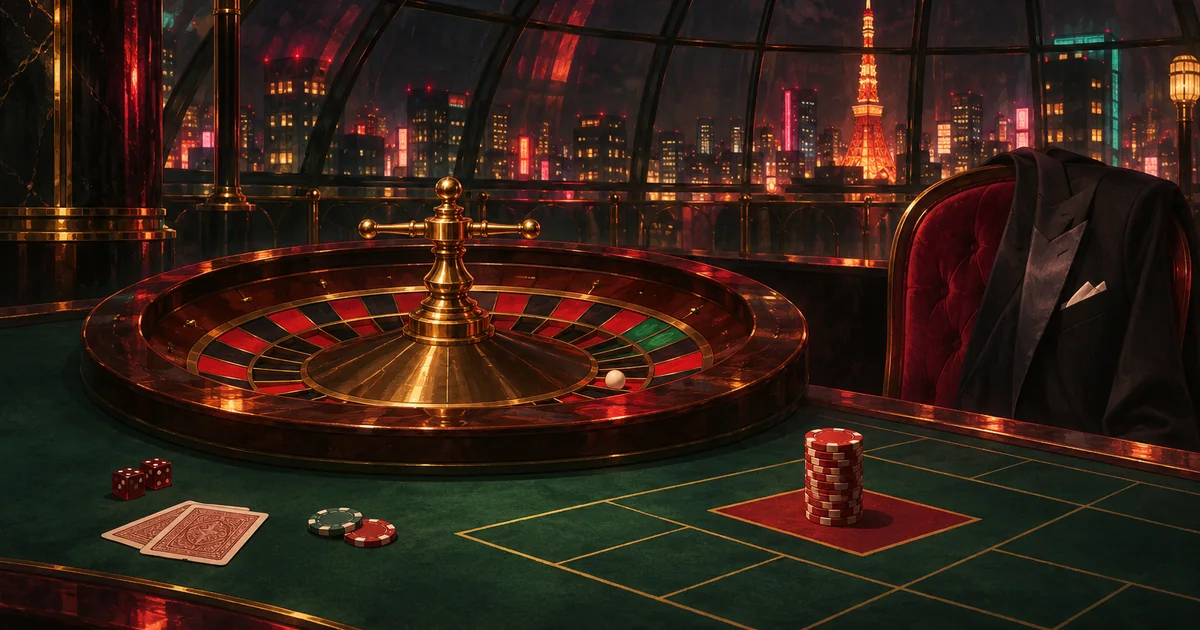
On Sunday 11 April 2004, which was Easter Sunday, Ashley Revell walked into the Plaza Hotel & Casino in downtown Las Vegas in a rented tuxedo. He was 32, from London, and, by Reuters’ account, had sold everything he owned in March, clothes included. He had $135,300.
It was not where the bet was meant to happen. Negotiations to place it at the Hard Rock Hotel broke down the night before, AP reported, and the Sky TV crew following him rewrote its script around a new theme: “The Bet Las Vegas Wouldn’t Take.” The Plaza took it. According to AP he traded his cash for chips and did some smaller gambling first; Reuters adds that earlier that week he had gambled about $3,000 trying to raise his pot and was $1,000 down by Wednesday.
Then he put $135,300 on red, as one double-or-nothing bet, while a film crew videotaped it. A Las Vegas Review-Journal columnist, cited by AP, reported that he chose red at the last minute, swayed by fan polls in Britain. “It all happened so quickly, it was spinning before I knew it,” he told Reuters. The ball bobbled through several pockets and stopped on red 7. He was paid $270,600 at the table.
The cash went into a safety-deposit box at the hotel, the Plaza gave him champagne and a suite, and he signed the felt for the lobby. He tipped the croupier $600. His father, who had flown in from London with his mother, told Reuters, “He shouldn’t have done it.” Asked about doubling again, Revell said no: “I don’t want to ride my luck.”
| ITEM | FIGURE |
|---|---|
| stake | $135,300 |
| bet | red |
| result | red 7 |
| paid | $270,600 |
| tip | $600 |
| wheel | double zero |
Stake, result and payout: AP and Reuters. Tip: Reuters. Wheel: inferred from the Plaza’s 2019 release, which called its new single-zero table downtown’s first and quoted Revell: single-zero roulette “wasn’t around back then.”
What one spin cost
An American wheel has 38 pockets: 18 red, 18 black, 0 and 00. Red wins on 18 of them, so the bet was a 47.37% chance, 10 to 9 against, and the Plaza’s 2019 release put it the same way: “less than fifty-fifty.” Every bet on that layout except the five-number 0-00-1-2-3 loses 2/38 of its stake on average, 5.26%. On $135,300 that is $7,121.
| ITEM | RESULT |
|---|---|
| red, 38 pockets | 47.37% |
| average cost | $7,121 |
| one SD swing | $135,112 |
| red, 37 pockets | 48.65% |
| average cost | $3,657 |
| tip vs payout | 0.22% |
Calculation for this article. 38 pockets: 18/38 to double, expected value −2/38 × $135,300. One SD: the standard deviation of the result, which dwarfs the price. 37 pockets: the same bet on a single-zero wheel, 18/37, expected value −1/37 × $135,300.
The price was small next to the swing. One standard deviation of the result was $135,112, nineteen times the $7,121 the house expected to keep. For a single bet the edge is almost invisible; what decides the night is which side of 47.37% the ball lands on.
Why splitting it was worse
The intuitive alternative is to spread the risk: bet the money in smaller pieces and stop at $270,600 or at nothing. On a game with a house edge it does the opposite. Each extra bet is another chance for the 5.26% to apply, so the more pieces, the worse the odds of doubling; doubling $100, priced shows the same effect at every stake.
| BETS | P(DOUBLE) | AVG SPINS | AVG LOSS |
|---|---|---|---|
| 1 | 47.37% | 1 | $7,121 |
| 2 | 44.75% | 4.0 | $14,203 |
| 5 | 37.13% | 24.5 | $34,836 |
| 10 | 25.85% | 91.8 | $65,341 |
| 20 | 10.84% | 297.6 | $105,968 |
| 50 | 0.51% | 940.3 | $133,913 |
Calculation for this article: gambler’s ruin with p = 18/38, P = 1 / (1 + (10/9)^n) for n equal bets. Average loss is $135,300 − $270,600 × P, which always equals 2/38 of the average total staked.
With ten bets of $13,530, about $1.24 million crosses the felt on average to win or lose the same $135,300, and the chance of doubling falls to about one in four. All-in on one spin is the least-bad way to try to double money at a game with an edge. Probabilists call it bold play: when every bet is even money and the odds are against you, betting everything, or just enough to reach the goal, is optimal, a result that goes back to Dubins and Savage’s 1965 book *How to Gamble If You Must*.
Could anything beat one spin?
On one spin, no. Whatever mix of bets you place, every dollar on the layout loses 2/38 on average, and a spin can never return more than you lose on it. Work that through and the best chance of doubling in one spin is 47.37%, reached only by staking everything so that any win lands exactly on $270,600: all on red, or, equally, $7,516.67 on each of 18 single numbers (calculation for this article).
Over several spins, slightly yes, and the reason is the same 2/38. If no win overshoots the goal, the chance of doubling is fixed by one quantity: how much you stake in total, on average. Bet less in total and you pay less edge. A long shot sized so that a win lands exactly on $270,600 stakes far less than $135,300 per attempt, and if it misses you still have most of the money to try again.
| PLAN | P(DOUBLE) | AVG STAKED |
|---|---|---|
| one red spin | 47.37% | $135,300 |
| 12 splits, stop | 47.73% | — |
| 12 splits, then red | 47.99% | $103,516 |
| split rule | 48.03% | $101,077 |
| number rule | 48.05% | $100,398 |
Calculation for this article, evaluated exactly. Splits pay 17 to 1 and each is sized so a win lands on $270,600: $7,958.82 first, rising to $14,924.79 by the twelfth. 12 splits, stop: 1 − (36/38)^12. Then red: the $1,953.74 left is played boldly on red. Split rule and number rule: a split (or a single number, 35 to 1) whenever the bankroll covers it, otherwise bold red.
The simplest version is the easiest to check: twelve split bets, each sized to win exactly the gap to $270,600, and stop if all twelve miss. The chance at least one hits is 1 − (36/38)^12 = 47.73%, more than one red spin. Keep the leftover $1,953.74 and play it boldly on red and the plan reaches 47.99%; bet a single number whenever you can afford one and it reaches 48.05%, for an average loss of $5,284 instead of $7,121. A full computer search over every American bet type found nothing better than about 48.06%.
The ceiling
There is a hard limit, and it is a pleasing one. If you go broke you must have staked at least $135,300 in total, and the edge takes 2/38 of everything staked. Put the two together and no plan at a double-zero table can double the money more than 18/37 = 48.65% of the time, which is exactly the chance of one red spin on a single-zero wheel. With ever-longer shots at the same edge the long-shot plan creeps towards about 48.14%, and in our numerical checks nothing beat that; treat it as a computed ceiling, not a proven one.
The house’s side
For the Plaza it was a bet it expected to win $7,121 on, with publicity attached. One bet is a gamble for the house too: it was behind 47.37% of the time. Repeat the same bet and the edge takes over, though more slowly than people think.
| BETS | HOUSE BEHIND |
|---|---|
| 1 | 47.37% |
| 10 | 31.41% |
| 100 | 26.50% |
| 1,000 | 4.48% |
Calculation for this article: exact binomial, the player winning more than half of N bets at 18/38. The house is about 95% sure to be ahead only after about 1,000 bets.
Revell gave it one. Out of 1,000 people making his exact bet, about 526 would have lost everything; his is the story of the other 474. Had he let it ride, two reds in a row would have been a 22.4% chance and five a 2.4% chance, before any table limit. He stopped, and how many bets before the edge shows is the long version of why stopping is the only part of that night the arithmetic approves.
The same bet on one zero
In November 2019 the Plaza invited Revell back to open downtown Las Vegas’ first single-zero roulette table with a ceremonial bet. Removing 00 changes every figure above. Red becomes 18 of 37, 48.65%; the edge on every bet halves to 1/37, 2.70%; and his $135,300 would have cost $3,657 on average instead of $7,121.
Betkyo’s roulette is a single-zero wheel with 37 pockets and the standard payouts, so the same arithmetic applies to it exactly.
| PLAN | P(DOUBLE) | AVG LOSS |
|---|---|---|
| one red spin | 48.65% | $3,657 |
| 12 splits, stop | 48.67% | — |
| number rule | 49.00% | $2,694 |
| 10 equal bets | 36.80% | — |
| ceiling | 49.32% | — |
Calculation for this article, from the ×2, ×18 and ×36 multipliers and 37 equally likely pockets, ignoring table limits and stake rounding. 12 splits, stop: 1 − (35/37)^12. Number rule: a straight-up sized to land on the goal whenever affordable, otherwise bold red. Ceiling: (1 − 1/37) / (2 − 1/37) = 36/73.
The same pattern holds at a third of the cost: one spin beats splitting the money into even-money pieces by a wide margin, a few long shots edge past one spin, and nothing reaches the ceiling. What never changes is the sign. Every plan loses money on average, and the only plans that look good are the ones that stake the least. If you play, set the amount you can lose before the first spin, the way the responsible-play toolkit suggests, and treat a win like Revell’s as the 474 in 1,000, not the plan.
One zero, 37 pocketsRed is 18 in 37, 48.65%: every bet on the layout returns 97.30% on averageRoulette →
What did Ashley Revell bet?
On Sunday 11 April 2004, Easter Sunday, he bet $135,300, everything he had after selling all his possessions, on red at the Plaza Hotel & Casino in Las Vegas. The ball landed on red 7 and he was paid $270,600. The bet had been planned for the Hard Rock, but talks there broke down the night before.
What were Ashley Revell’s odds?
The Plaza’s 2019 release implies a double-zero wheel, so red won on 18 of 38 pockets: 47.37%, 10 to 9 against. The expected cost of the bet was 2/38 of $135,300, about $7,121. On a single-zero wheel the same bet would have been 48.65% and cost about $3,657.
Is it better to bet everything on one spin or split it up?
If the goal is to double the money with even-money bets, one spin is better. Split into ten equal bets played to double or bust, the chance falls from 47.37% to 25.85%, because every extra bet pays the edge again. That does not make the bet a good idea: both lose money on average.
Can any roulette strategy beat one spin on red?
On one spin, no. Over several spins, long shots sized so that a win lands exactly on the goal do slightly better, because they stake less in total: twelve split bets double 47.73% of the time on a double-zero wheel, a single-number rule 48.05%. No plan at that table can reach 48.65%, and every plan still loses money on average.
Did Ashley Revell bet again?
He said no that night: “I don’t want to ride my luck.” In November 2019 the Plaza invited him back to place a ceremonial bet on its new single-zero table; the result of that bet was not reported in the sources used here.
- AP via CBS News, “He Bets Life Savings, Wins $270K”, 12 April 2004 — the stake, the videotaped spin, cash for chips, red 7, the payout, the Hard Rock talks, the fan polls, the safety-deposit box, the signed felt
- Reuters via NBC News (page dated 8 April 2004) — the 32-year-old Londoner, selling everything in March, the week before, the $600 tip, “Double or Nothing”, the quotes from Revell and his father
- Plaza Hotel & Casino release, 28 October 2019 — “less than fifty-fifty”, the first single-zero table downtown, Revell’s quote, the 2 November 2019 ceremonial bet
- Kyle Siegrist, Random (University of Alabama in Huntsville), red and black: bold play is optimal in the unfair even-money game
- Betkyo engine source: deriveRouletteSpin() in roulette/derive.ts, RouletteEngine.derivePocket(), and the settlement multipliers
- Calculation for this article: the one-spin chances, expected values and standard deviation; gambler’s ruin for n equal bets; the one-spin bound; the long-shot plans evaluated exactly on 38 and 37 pockets; the 18/37 and 36/73 ceilings and the numerical long-shot limit; the binomial house figures; letting it ride