
When randomness was a voice
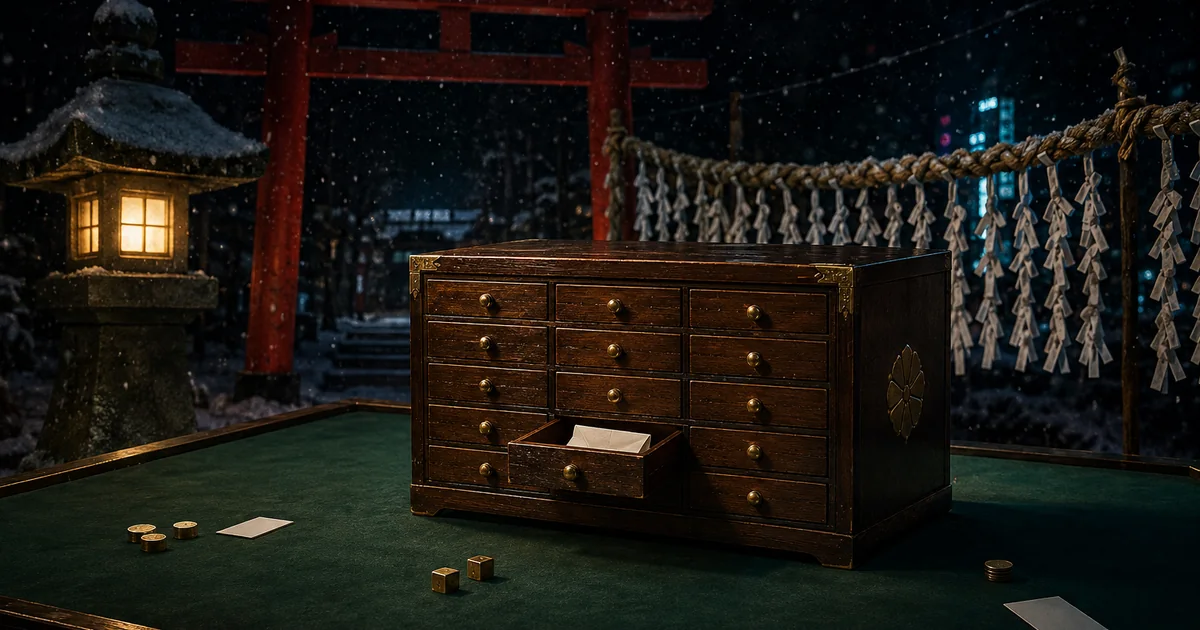
The oldest randomizers were not toys but instruments of communication. Astragali — the ankle bones of sheep and goats, naturally four-sided — were cast across the ancient Mediterranean for both games and divination. China read the fall of yarrow stalks through the I Ching. Ancient Israel cast lots; Japan drew kuji before its gods seriously enough to choose a shōgun by lot in 1428. The premise everywhere was the same: an outcome no human hand can steer must carry a will beyond human hands.
Notice what this era already understood: the entire value of the ritual depended on it being unriggable. A priest who palmed the lot destroyed not just a game but a channel to the divine. Fairness technology is older than probability itself.
The object becomes honest
Cubical dice appear thousands of years ago, and with them a quieter kind of trust: not in gods but in symmetry. A fair die is honest because of its geometry; anyone may inspect it, roll it, weigh it. Casinos still live in this era every time a dealer spreads a fresh deck face-up — the object itself is the proof.
The mathematics arrived embarrassingly late. Gerolamo Cardano — physician, astrologer, compulsive gambler — wrote the first real treatise on games of chance in the sixteenth century (published only in 1663, long after his death). The famous 1654 correspondence between Pascal and Fermat, prompted by a gambler’s question about dividing the stakes of an unfinished game, turned chance into a calculable object. Probability theory was born not in a university but at a card table.
Machines and inspectors
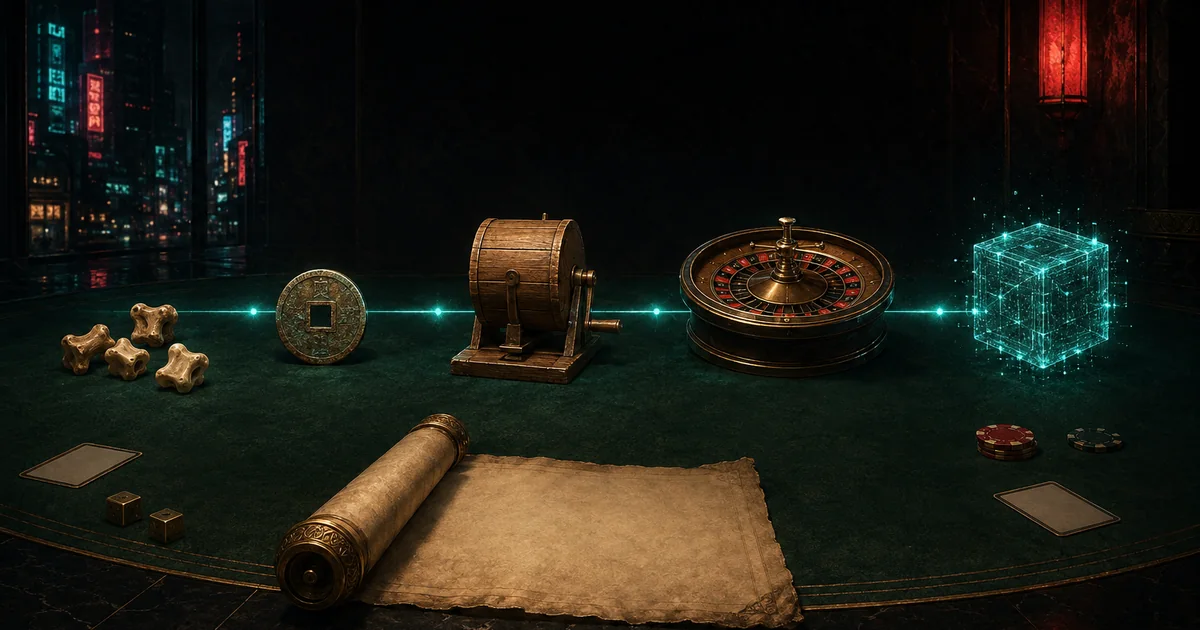
The twentieth century needed randomness at industrial scale — for statistics, simulation, cryptography and state lotteries — and physical dice do not scale. The RAND Corporation built an electronic roulette in the late 1940s and published the result as a book, “A Million Random Digits” (1955), which working statisticians actually bought. Britain answered with ERNIE (1957), the Electronic Random Number Indicator Equipment, which drew Premium Bond winners from the thermal noise of neon tubes.
Computers posed a paradox: a deterministic machine cannot produce true randomness at all. John von Neumann, who devised one of the first pseudo-random generators, said it plainly: “Anyone who considers arithmetical methods of producing random digits is, of course, in a state of sin.” Pseudo-randomness — sequences that only look random — turned out to be enough for almost everything, and the craft became making them look random enough. The workhorse of the modern era, the Mersenne Twister (1997), came from two Japanese mathematicians, Makoto Matsumoto and Takuji Nishimura.
Gambling in this era settled on institutional trust: certified hardware generators, testing laboratories, regulators, license numbers on the footer. It works — but the player’s only verification is a logo. You cannot re-roll an inspector.
The current era: nobody needs to be honest
Cryptography changed the question. A hash commitment lets a house lock its randomness in place before your bet and prove afterward that nothing moved — the commit-reveal scheme behind provably-fair gaming. Public randomness beacons like NIST’s (2013) and drand (2019, run by a league of independent organizations) publish verifiable random pulses no single member can steer. Verifiable random functions produce numbers that arrive with their own mathematical proof attached. Even the physical era got a cryptographic sequel: a wall of lava lamps, filmed, hashed, feeding entropy into infrastructure that serves a large share of the web.
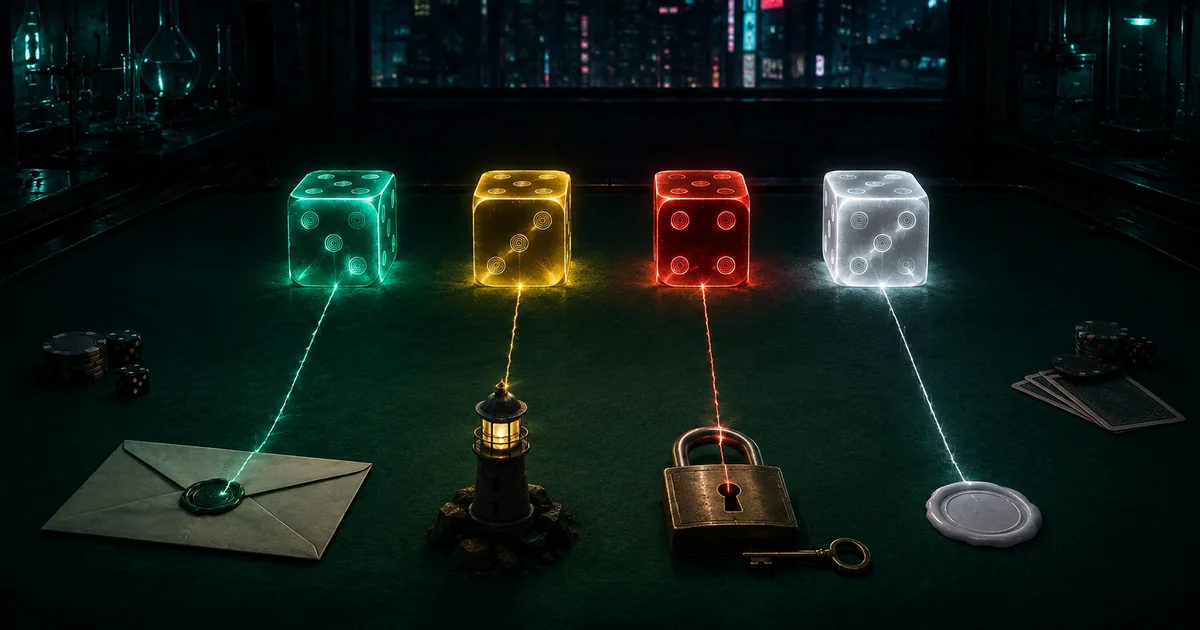
The through-line of the whole story: each era relocated trust — from gods, to objects, to institutions, to mathematics anyone can run. A provably-fair round is the shrine lot with the theology replaced by SHA-256: the box is finally transparent.
One free roll, one committed seed, one verifiable result — the whole history in a click.Dice →
What is the oldest known randomizer?
Astragali — the four-sided ankle bones of hoofed animals — are among the oldest, used across the ancient world for games and divination long before cubical dice standardized the shape of chance.
Why can’t a computer produce true randomness?
A deterministic machine given the same state always produces the same output. Computers therefore either harvest entropy from the physical world (noise, timing, hardware sensors) or stretch a small true-random seed into a long pseudo-random sequence — which is exactly what makes committed seeds auditable.
Is pseudo-randomness good enough for gambling?
Cryptographic pseudo-randomness is — the sequences are computationally indistinguishable from true randomness, and in a commit-reveal scheme the determinism becomes a feature: it is what lets you recompute and verify a past round exactly.
- Gerolamo Cardano, Liber de ludo aleae (written 16th c., published 1663)
- Pascal–Fermat correspondence on the problem of points, 1654
- RAND Corporation, A Million Random Digits with 100,000 Normal Deviates (1955)
- ERNIE and Premium Bonds — UK National Savings, 1957
- M. Matsumoto & T. Nishimura, “Mersenne Twister” (1997)
- drand / League of Entropy — distributed randomness beacon