
Two facts that should not coexist
Japan’s criminal code prohibits gambling, with narrow carve-outs for a handful of state-run activities — public sports betting on horses, bicycles, boats and motorcycles, plus the lottery. Casinos were not among them for the whole of the modern era.
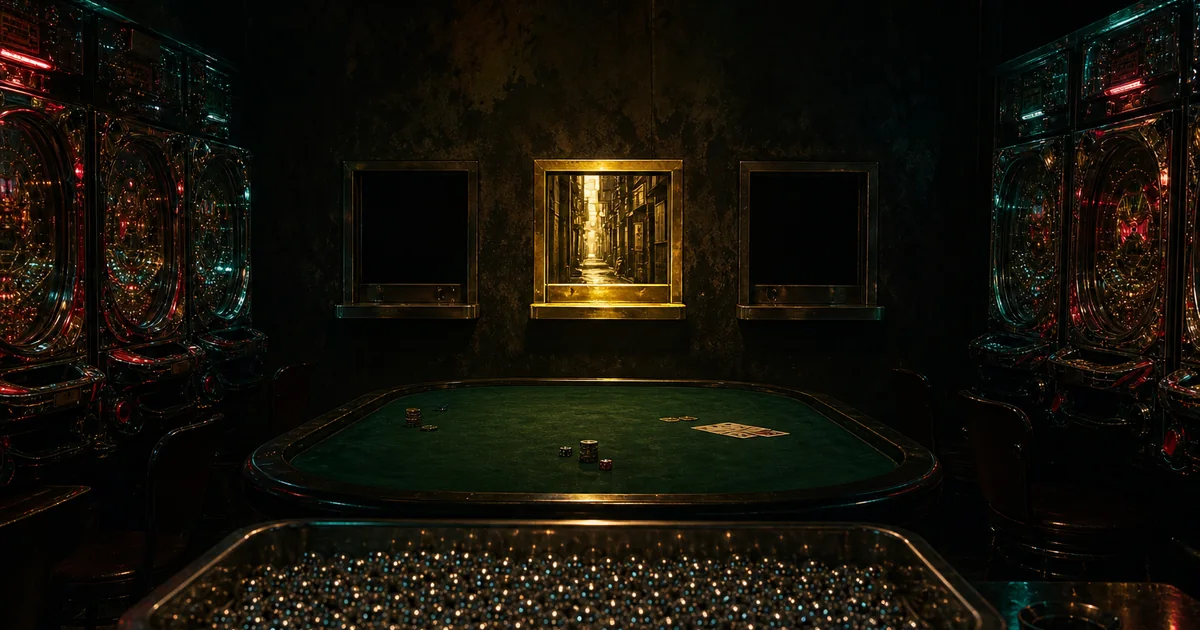
Japan also has, on ordinary streets in ordinary towns, halls of upright machines where players buy small steel balls, launch them into a field of pins, and win more balls when the balls fall correctly. People play for hours. Serious money changes hands.
The reconciliation is not a loophole in the careless sense. It is a deliberately maintained structure that everyone — players, operators, regulators — understands perfectly, and which nonetheless holds, because each individual step in it is lawful.
The three-shop system
The mechanism is a chain of three parties who are, formally, strangers to one another.
- The parlour takes money for balls and pays winnings in balls. Balls are not money. You may exchange them, inside the parlour, for goods — historically anything from chocolate and cigarettes to household items — including a small token containing a sliver of gold or silver.
- The prize counter is a separate business, typically a small window a short walk away, which buys those tokens for cash. It is purchasing an object, which is a lawful transaction.
- A wholesaler buys the tokens from the counter and sells them back to the parlour, so the same tokens circulate.
No single business both runs a game of chance and pays money for its outcome. The parlour gave you a thing; a different business bought the thing. That the loop closes, and that everyone knows it closes, is not legally decisive so long as the parties are genuinely separate entities.
The scale of the thing
For much of the post-war era pachinko was the largest single category of leisure spending in Japan — routinely reported as exceeding the combined revenue of the country’s film, music and publishing sectors, and at its peak in the 1990s handling annual sums in the tens of trillions of yen.
Those figures deserve a caution: pachinko revenue is usually quoted as total money staked rather than as operator profit, which is the same distinction that makes a casino’s “handle” a much larger number than its take. Comparisons across sources are frequently comparing different quantities.
What is not disputed is the direction of travel. The industry has contracted substantially from its peak — parlour counts and player numbers have fallen for years, driven by an ageing player base, competition from mobile entertainment, and successive regulatory tightening of how much a machine may pay.
That last lever is worth noting, because it is the state regulating the volatility of a thing it does not officially recognise as gambling. Machine payout characteristics are constrained by rule, which is precisely the kind of oversight a gambling regulator applies.
Why the story matters beyond Japan
Pachinko is the clearest demonstration available that prohibition rarely removes demand for chance. It relocates it — into a structure shaped by whatever the law happens to permit, and staffed by whoever is willing to operate at the boundary.
The same pattern recurs everywhere. Edo-period Japan banned gambling and got the itinerant gambling houses that seeded organised crime. Prohibition-era America banned drink and got the speakeasy. In each case the activity persisted, the regulation was replaced by an informal one, and the informal one was worse.
It is also a lesson about design. Pachinko machines are not incidental to the story — they are among the most refined engagement machines ever built, with escalating audiovisual sequences, near-miss animations and long dry stretches punctuated by extended payout runs. The legal architecture explains why the industry could exist; the machine design explains why it grew.
Japan legalised casino resorts in 2018 after decades of debate, in part on the argument that a regulated venue is better than an unregulated proxy. Whether that proves true, the debate itself was an admission that the proxy had been doing the job all along.
Our own Japanese reel gameTairyō: 5×3, ten lines, and a published capTairyō →
Is pachinko legal gambling in Japan?
Pachinko is legal precisely because it is not classified as gambling. Players win balls, exchange them for prizes in the parlour, and sell those prizes for cash at a legally separate business — so no single entity pays money for a game of chance.
What is the three-shop system?
The chain of three formally unrelated parties — parlour, off-premises prize buyer and wholesaler — that lets pachinko winnings become cash without any one of them both running the game and paying out money.
How big is the pachinko industry?
Historically one of the largest leisure sectors in Japan, with peak figures in the tens of trillions of yen — though those are usually total money staked rather than operator revenue. The industry has contracted substantially since the 1990s.
Why does Japan allow it if gambling is banned?
Because each individual step is lawful and the parties are separate entities. Machine payouts are nonetheless regulated by the state, which is the same oversight a gambling regulator applies.
- Standard accounts of the three-shop system (三店方式) and Japan’s gambling prohibition with its state-run exceptions; revenue figures vary widely between sources and usually report money staked rather than operator revenue